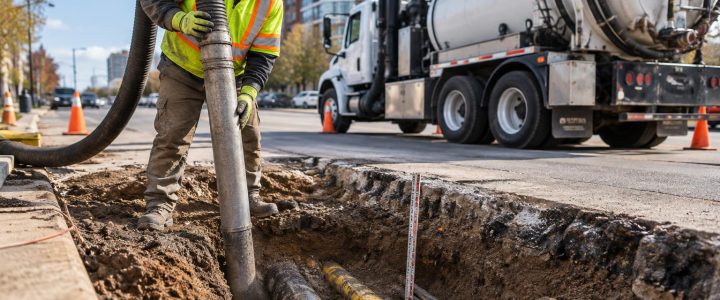
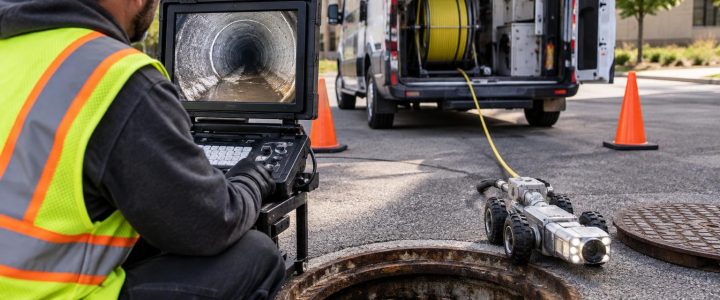
When a project needs more than a painted mark or an estimated depth, a utility test hole can provide the field evidence needed to move forward. Vacuum excavation gives crews a controlled way to remove soil around a known or suspected utility so its actual position and observable characteristics can be documented.
Both hydro excavation and air excavation use a vacuum system to remove loosened soil from a small excavation. The difference is the loosening method: hydro excavation uses pressurized water, while air excavation uses compressed air. Neither method is automatically right for every site. The best choice depends on the soil, the utility being exposed, disposal requirements, restoration expectations, access, weather, and the information the project team needs.
For civil engineers, SUE professionals, and contractors, the important question is not simply whether to use vacuum excavation. It is whether hydro or air excavation will expose the target utility efficiently and responsibly while supporting useful documentation for design or construction.
Why method selection matters for utility verification
Utility records, as-builts, and design drawings are valuable references, but they may not show current field conditions. A utility may have been installed at a different alignment or depth than expected. Later reconstruction, grade changes, repairs, abandoned infrastructure, or incomplete records can also create uncertainty.
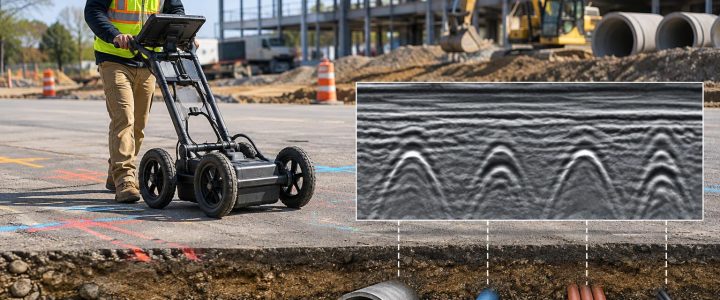
Private utility locating, electromagnetic designation, and ground penetrating radar can help identify suspected utility routes. These methods may provide an interpreted horizontal position and an estimated depth under favorable conditions. However, they do not always provide the confidence needed to confirm a utility’s actual depth, outside diameter, material, conduit arrangement, or vertical relationship to another utility.
Utility potholing or daylighting allows the investigator to physically observe the exposed infrastructure. Depending on the exposure and site conditions, the team may be able to document:
- The actual horizontal position at the test-hole location
- Depth measured from an agreed surface reference
- Top, centerline, or invert information, when applicable and accessible
- Visible pipe size or outside diameter
- Pipe, conduit, cable, casing, or duct-bank configuration
- Observable material characteristics
- The number and arrangement of visible conduits
- Vertical separation at a crossing or conflict point
- Conditions that differ from plans, records, or geophysical marks
A physically exposed utility still may require survey support when the project needs precise coordinates or elevations. A depth measurement taken at the excavation is not automatically a surveyed elevation. Survey control, an agreed datum, and appropriate measurement procedures are needed when design decisions depend on reliable horizontal and vertical coordinates.
How hydro excavation works
Hydro excavation uses controlled water pressure to break up soil. A vacuum hose removes the water-and-soil mixture into a debris tank. Crews can then work in small increments as they approach the designated or suspected utility.
Hydro excavation is often a practical choice where soil is dense, dry, compacted, or cohesive. Water can help loosen material that would be slow to remove with air alone. It may also be useful where production needs and test-hole quantity make efficient soil removal important.
Advantages of hydro excavation
- Can be effective in many compacted or cohesive soils
- Often removes material efficiently for larger or deeper utility exposure areas
- Can help manage dry, dusty excavation conditions
- May be a practical option for utility daylighting where surface restoration is already planned
Hydro excavation limitations to plan for
- The process creates slurry that must be contained, transported, and disposed of appropriately.
- Water can migrate in granular soils or low areas, which may complicate the work area.
- Wet spoil can affect restoration planning, particularly in landscaped areas or locations with limited room.
- Frozen ground, water availability, winter conditions, and environmental controls can affect productivity.
- Pressure, nozzle distance, approach angle, and operator technique matter. Water excavation is not risk-free around utilities.
Hydro excavation should be treated as an active excavation operation, not a shortcut around planning. The target area should be reviewed, utilities should be designated where feasible, and the crew should use an exposure approach suited to the suspected utility and soil conditions.
How air excavation works
Air excavation uses compressed air to loosen soil, which is then removed by vacuum. The excavated soil is typically dry or much drier than hydro-excavated spoil, depending on existing ground moisture.
For some sites, dry spoil is the deciding factor. Air excavation can be helpful when project conditions favor keeping excavated material dry, minimizing added water, or returning suitable material to the hole during restoration. It can also be useful around sensitive areas where introducing water would create a practical problem.
Advantages of air excavation
- Usually avoids creating liquid slurry from added water
- May simplify spoil handling and restoration where excavated material can be reused
- Can be a good fit for sensitive landscaped areas, interior-adjacent work, or sites with limited slurry-handling options
- May help crews expose complex conduit configurations without saturating the excavation
Air excavation limitations to plan for
- Very hard, rocky, cemented, or heavily compacted soils can be slower to loosen.
- Airborne dust, displaced soil, and debris require control measures appropriate to the work area.
- Wet, sticky clay can be difficult to break apart and remove efficiently.
- Noise from compressors and vacuum equipment may affect work near occupied facilities or restricted hours.
- Operator technique remains important, especially when approaching exposed cable, conduit, coatings, or fragile infrastructure.
Air excavation is not inherently “gentler” in every circumstance. The correct process depends on the equipment, the soil, the utility type, the exposure plan, and the qualifications of the crew. A project team should avoid selecting a method solely because it is labeled non-destructive.
Hydro excavation vs. air excavation: practical selection factors
Instead of treating hydro and air as competing services, treat them as tools for different field conditions. A vacuum excavation contractor should evaluate the target utility, the expected soil profile, and the final deliverable before mobilizing.
Soil and groundwater conditions
Hydro excavation may be productive in dense or dry soil that can be broken up with water. Air excavation may be attractive where soil can be removed effectively without adding water. Groundwater, saturated soils, sticky clay, cobbles, and buried construction debris can affect either method. In difficult conditions, the work plan may need to include slower production, additional test holes, or a modified exposure area.
Utility type and the information needed
A small gas service, direct-buried electrical cable, telecom duct bank, water main, and concrete-encased utility bank present different exposure challenges. The crew needs to know whether the objective is a simple confirmation point, a measurement of pipe diameter, a view of a crossing, or enough exposure to understand a complex configuration.
For example, confirming that a single conduit exists at one station may require only a compact pothole. Confirming the arrangement of several conduits, a casing, or a utility crossing may require a longer or wider controlled excavation. The exposure should be large enough to support the decision at hand without unnecessarily disturbing surrounding ground.
Disposal and restoration
Hydro excavation creates wet spoil or slurry, so disposal planning is essential. Air excavation may produce material that is more suitable for reuse, but that decision depends on the material, contamination concerns, specification requirements, and the restoration plan. Do not assume excavated material can be placed back into a test hole without project approval.
Access, traffic, and work-zone constraints
Vacuum trucks, hoses, water supply, spoil capacity, lane closures, pedestrian routes, overhead clearances, and staging space all affect method selection. A technically suitable approach can still be impractical if the crew cannot safely position equipment or control the work zone. Urban corridors, active campuses, hospitals, industrial facilities, and roadway projects often need detailed logistics planning before utility daylighting begins.
How vacuum excavation supports Quality Level A investigations
In a Subsurface Utility Engineering investigation, Quality Level B generally involves geophysical designation of utility routes. Quality Level A involves obtaining detailed information through exposure and precise measurement at selected points. The American Society of Civil Engineers describes ASCE 38-22 as a standard for investigating and documenting existing subsurface utility infrastructure, while the Federal Highway Administration recognizes SUE as a process for reducing utility-related uncertainty in project development.
Physical exposure is an important part of obtaining Quality Level A information, but a vacuum excavation project does not automatically meet every Quality Level A requirement. The work must be planned, performed, measured, and documented in a manner that fits the investigation scope and applicable project standards.
A strong SUE and QL-B investigation can help identify where test holes will provide the most value. Vacuum excavation then provides a means to observe the utility at those targeted locations. Surveying may be added to tie the exposed point to project control and document the required elevation or coordinate information.
When to specify hydro or air utility test holes
Engineers and contractors should consider utility test holes when uncertainty could affect safety, constructability, cost, schedule, or the proposed design. Common triggers include:
- A proposed storm, sanitary, water, or electrical installation approaches a known utility.
- Plans show two utilities crossing, but vertical separation is unknown.
- A directional drilling bore path needs verification at critical crossings.
- Available records conflict, omit utility size, or do not show reliable depth information.
- A design profile depends on the actual elevation of an existing utility.
- A contractor needs to daylight a utility before mechanical excavation works nearby.
- A duct bank, casing, or unknown conduit configuration needs physical confirmation.
For planned work, select test-hole locations based on decision points, not simply convenient access. The highest-value locations often include proposed crossings, low points, tie-in areas, utility congestion zones, bore entry and exit areas, and locations where the design has little vertical clearance.
A practical field workflow for utility exposure
- Define the decision. Identify what the project needs to know: position, depth, elevation, size, material, configuration, crossing relationship, or condition.
- Review available information. Compare records, design drawings, utility marks, prior investigations, and site constraints.
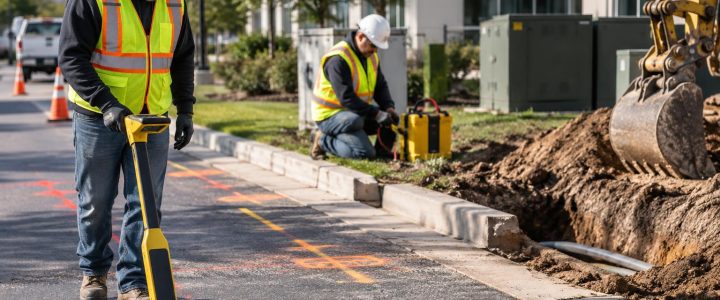
- Designate before exposing where feasible. Private locating and other investigation methods can help target the excavation and reduce unnecessary disturbance.
- Select the excavation method. Consider soil, water, spoil handling, environmental requirements, restoration, access, and the utility type.
- Expose carefully and document observations. Record the reference point, measurements, visible characteristics, photographs if required, and any variance from expected conditions.
- Add survey control when required. Coordinate survey work where the design requires elevations or coordinates tied to a project datum.
- Communicate the result. Provide information in a usable format so designers, field crews, and project managers understand both the finding and its limits.
Common mistakes to avoid
- Treating an estimated locator depth as a verified depth. Estimated depth and measured depth are not interchangeable.
- Ordering a test hole without defining the required deliverable. A small exposure may confirm one question but not answer another.
- Failing to plan for spoil and surface restoration. Slurry, dry spoils, pavement, landscaping, and access conditions should be addressed before work begins.
- Assuming one exposed point describes an entire utility run. Utilities can change grade, direction, depth, or configuration between test holes.
- Skipping survey coordination. If a design relies on elevation, establish how the exposed utility will be measured and tied to control.
Frequently asked questions
Is hydro excavation safer than mechanical digging around utilities?
Vacuum excavation is commonly used to reduce the risk associated with mechanical excavation near known or suspected utilities because it allows more controlled soil removal. It does not eliminate risk. Appropriate locating, work planning, trained operators, utility owner requirements, and jobsite safety controls remain necessary.
Can air excavation verify utility depth?
It can expose a utility so depth can be measured from a defined surface reference. If the project requires a precise elevation tied to a datum, survey procedures are needed in addition to physical exposure.
Can vacuum excavation identify pipe material and size?
Physical exposure may allow observable characteristics such as outside diameter, visible material, casing presence, conduit count, or duct-bank arrangement to be documented. The extent of verification depends on how much of the utility is safely exposed and what can be observed.
Which is better for utility daylighting: hydro or air?
Neither is universally better. Hydro excavation may be more effective in certain dense soils, while air excavation may be preferable where dry spoil handling or reduced water use is important. Site conditions and project requirements should drive the decision.
Plan the test hole around the project decision
Effective utility daylighting is more than digging a small hole. It is a targeted investigation that connects locating, field exposure, measurement, documentation, survey coordination, and construction planning. Choosing between hydro excavation and air excavation is part of that process.
Visionary Subsurface Solutions provides vacuum excavation and QL-A utility exposure services for projects throughout Pennsylvania, New Jersey, Delaware, Maryland, New York, and the Washington, D.C. to New York City corridor. Contact our team to discuss the utility questions, site conditions, and documentation needs for your project.