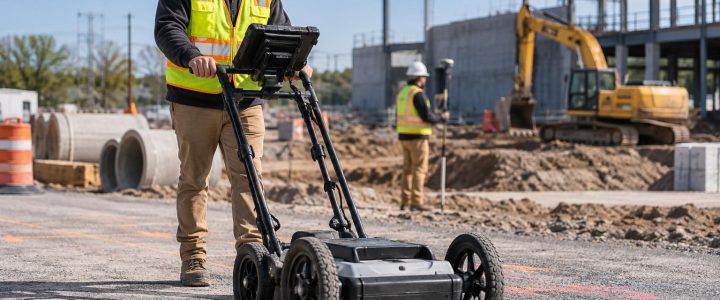
PVC, HDPE, fiberglass, concrete, and other non-metallic utilities create a common pre-excavation problem: the pipe itself generally cannot carry the signal used by an electromagnetic utility locator. If a conductive tracer wire, detectable tape, or metallic component is present, however, electromagnetic utility locating can often help a qualified locator trace a likely route and mark it for planning.
That distinction matters. An EM locate does not directly “see” a plastic pipe. It detects an electromagnetic field on the tracer wire or other conductive target. The resulting marks are valuable for utility locating before excavation, but they should be treated as a field interpretation—not physical proof of the pipe’s exact centerline, depth, size, condition, or connection.
For contractors and engineers working around private water lines, force mains, gas services, irrigation systems, electrical conduits, communications duct banks, and site drainage, tracer wire utility locating is often an important part of a broader utility investigation. Where excavation will come close to a marked utility, vacuum excavation or other approved exposure methods may still be needed to verify the actual facility.
Why plastic utilities are difficult to locate
An electromagnetic utility locator detects a signal carried by a conductive path. Metallic pipe, cable, conduit, or tracer wire can serve as that path. Plastic pipe by itself cannot normally carry a trace signal in the same way because it is non-conductive.
Many modern non-metallic pressure pipes and conduits are installed with tracer wire for this reason. The wire is often routed along the pipe so it can be accessed at a valve box, cleanout, pedestal, handhole, riser, meter area, or other connection point. A locator can apply a signal to the wire and follow the field from above ground.
The presence of tracer wire does not automatically make a plastic utility easy to locate. The wire may be broken, disconnected, poorly grounded, buried separately from the pipe, looped through a valve box, or bonded to another conductive facility. Older private utilities may have no detectable component at all.
How electromagnetic locating follows tracer wire
In active electromagnetic utility locating, a transmitter applies a controlled signal to a conductive target. The receiver is then used to detect and trace that signal from the surface. The locator evaluates the signal response to estimate the target’s horizontal route and, under suitable conditions, an approximate depth.
Direct connection
Direct connection is often the preferred approach when the tracer wire can be safely accessed. The locator connects a transmitter lead to the wire and uses a second lead or ground stake to complete the circuit. A well-established connection can put a clearer, more controllable signal on the target than a broadcast method.
Before connecting, the locator needs to understand what the accessible wire may be connected to. A wire in a valve box, pedestal, handhole, electrical enclosure, or service area may not be isolated. Site conditions and safe-work practices determine whether connection is appropriate.
Induction
With induction, a transmitter placed on the ground generates a signal that may couple onto nearby conductors. This method can be useful when there is no accessible connection point. It also has a major limitation: the signal can couple onto more than one nearby utility.
On a congested site, induction may identify possible conductive routes, but it may be difficult to establish which route corresponds to the intended tracer wire. A professional utility locator will compare signal behavior, available access points, records, surface features, and other evidence rather than relying on one response alone.
Clamp coupling
A signal clamp can be placed around an accessible cable or wire without making a direct metal-to-metal connection. This may be useful where a direct connection is impractical or where isolating the target is important. A clamp works on a conductor that can be enclosed by the clamp; it is not a solution for a buried plastic pipe without a reachable conductive element.
What EM markings on a tracer wire actually mean
A paint mark or flag from electromagnetic pipe locating usually represents the interpreted surface projection of the traced conductor. If the tracer wire was installed directly with the pipe and remains continuous, its route may closely represent the pipe route. That cannot be assumed without considering how the facility was installed and maintained.
Several conditions can create a meaningful difference between the traced wire and the pipe:
- The wire may have been placed beside, above, or below the pipe rather than taped directly to it.
- The wire may have shifted during installation or backfill.
- The wire may cross over the pipe at fittings, branches, repairs, or access structures.
- A damaged wire can stop carrying the signal beyond a break.
- One continuous wire may serve multiple branches, making routing at tees and crossings less clear.
- The signal may transfer onto nearby metallic pipe, cable, fence, rebar, or grounding systems.
For this reason, a locate report should communicate the method used, accessible connection points, signal behavior, limitations observed, marked routes, and areas where the result is uncertain. Clear communication is especially important before trenching, directional drilling, boring, piling, or excavation near a proposed utility crossing.
Depth estimates: useful, but not excavation clearance
Many EM receivers can calculate an estimated depth to a traced conductor. This estimate is based on the detected field and the locator’s assumptions about the signal path. It is not a direct measurement of pipe depth.
For a plastic line with tracer wire, the displayed depth is generally an estimate to the wire, not necessarily the crown, center, or invert of the pipe. If the wire is offset from the pipe, the difference may matter. A depth reading can also become less reliable when the signal is distorted by nearby conductors, a bend, a tee, poor grounding, a partial break, or a congested corridor.
A sound field practice is to take depth estimates at multiple points while tracing the route, assess whether the readings are consistent with site conditions, and identify changes that need further investigation. Do not use an EM depth estimate as authorization to excavate to a specific elevation without appropriate tolerance-zone practices and, when necessary, physical verification.
Common reasons a tracer-wire locate becomes uncertain
Locating non-metallic utilities with tracer wire can be straightforward in open ground with an isolated, continuous wire. It becomes harder when signal quality or site access is poor.
Broken or disconnected tracer wire
A wire can be cut during repairs, corroded at a connection, or left unconnected at one end. The locator may trace the wire to the break, but the signal may not continue beyond it. A loss of signal does not confirm that the pipe ends at that point.
Signal bleed-off and coupling
Applied signal can travel onto other metallic paths through contact, proximity, grounding, or shared structures. This is often called coupling or bleed-off. A locator may detect a strong signal on a nearby conductor even though it is not the intended utility. Changes in signal strength, current response, and field shape can help identify these conditions, but they do not eliminate the need for judgment.
Parallel utilities and crossings
Parallel metallic utilities can distort the field and make it difficult to separate one route from another. At crossings, a signal may appear to jump, split, weaken, or change direction. This is common near building entries, utility rooms, roadways, campus corridors, pump stations, industrial facilities, and dense commercial sites.
Access and grounding limitations
A direct connection may not be available, and an acceptable ground may be difficult to establish in paved, dry, frozen, or highly congested areas. Poor access can limit the available locating methods and lower confidence in a trace.
Which non-metallic facilities may be traceable?
EM utility locating may be appropriate for a non-metallic facility when there is a continuous conductive feature that can carry a usable signal. Examples may include:
- PVC or HDPE pressure pipe installed with tracer wire.
- Non-metallic conduit containing an accessible metallic cable or pull wire.
- Plastic pipe with a metallic fitting, valve, riser, or other accessible component.
- Some detectable tape systems, when the tape includes a conductive element and remains continuous.
- Non-metallic sewer or drainage pipe containing an inserted sonde from a pipe inspection system, where access and pipe condition allow.
By contrast, a buried plastic, fiberglass, or concrete line with no tracer wire, metallic component, accessible cable, or inserted transmitter generally cannot be directly traced with standard EM equipment. In those situations, the investigation may need another method, such as ground penetrating radar where site conditions support it, CCTV with a sonde for accessible pipelines, record research, surface-feature review, or carefully planned test holes.
Where EM locating fits in construction planning
Electromagnetic locating is a practical tool for utility locating for construction, but it is only one part of utility risk management. Public 811 markings should be requested before excavation as required by the applicable state process. Those markings commonly address facilities owned or maintained by participating utility operators. They may not identify privately owned facilities beyond the point of service, on commercial properties, within campuses, or serving site infrastructure.
A private utility locating investigation can supplement the 811 process by evaluating private-side utilities that could affect planned work. The scope should be tied to the planned disturbance area, utility types expected, available access, site history, and consequence of a conflict.
For engineering design, EM designation can contribute information used in a Subsurface Utility Engineering investigation. Under ASCE 38-22, Quality Level B involves the use of appropriate geophysical methods to designate the horizontal position of subsurface utilities. An EM trace alone does not automatically create a complete SUE deliverable or resolve every utility on a site. The investigation must be planned, documented, and managed to meet the project’s stated quality needs.
When to move from EM locating to vacuum excavation
Use physical exposure when the project needs to confirm a utility’s actual horizontal position, vertical position, size, material, or configuration at a critical point. This is commonly appropriate at proposed crossings, tie-ins, deep excavations, bore paths, structure foundations, utility relocations, and locations where marks conflict with records or visible features.
Vacuum excavation can expose a limited area with less disturbance than conventional mechanical digging when performed with a suitable work plan. It provides the direct observation needed to confirm what an EM signal could only indicate. Learn more about vacuum excavation and Quality Level A verification when test holes are needed for design or construction decisions.
Pre-locate checklist for contractors and engineers
- Request 811 utility notification before excavation and preserve existing marks until the work is complete or remarks are needed.
- Define the actual disturbance area, including staging, access routes, shoring, drilling, grounding, and temporary works.
- Provide available utility records, as-builts, site plans, prior locate reports, and planned excavation limits to the locating team.
- Identify accessible valve boxes, cleanouts, handholes, meters, electrical rooms, utility pedestals, and building entries.
- Clear safe access to the work area and identify locked areas, traffic controls, pavement, vegetation, or other site restrictions.
- Discuss which conflicts require test holes before construction begins.
- Review marks and findings with the excavation crew during pre-task planning; do not treat a mark as a confirmed exposed utility.
Frequently asked questions
Can an EM utility locator find PVC pipe?
Not directly in most cases. EM equipment may trace a conductive tracer wire, detectable tape, metallic fitting, or inserted transmitter associated with the PVC pipe. The result should be interpreted as the route of the detected conductive target.
Can a tracer wire locate confirm pipe depth?
It can provide an estimated depth to the traced wire under favorable conditions. It does not confirm the pipe’s exact depth or elevation. Exposure is needed when exact position is critical.
Can a tracer wire locate tell whether a line is active?
No. Detecting a signal on tracer wire does not establish whether the associated pipe is active, abandoned, pressurized, or in service. Records, owner information, field observation, and appropriate verification are needed.
Should a private locator be called for plastic utilities?
Yes, particularly when private-side plastic utilities may be within or near planned excavation. A professional locator can assess accessible tracer wire and other detectable components, explain the limitations of the findings, and recommend additional investigation where risk remains.
Plan the investigation around the excavation risk
Tracer wire can make non-metallic utility routes more traceable, but it is not a substitute for a defined locating scope, careful interpretation, or physical verification at critical points. The right approach is to use electromagnetic utility locating to reduce uncertainty, then escalate to other methods when the remaining uncertainty could affect safety, design, schedule, or damage risk.
Visionary Subsurface Solutions provides private utility locating, SUE support, and test-hole services throughout Pennsylvania, New Jersey, Delaware, Maryland, New York, and the Washington, D.C. to New York City corridor. Contact our team to discuss the utilities on your site, the planned work, and an investigation approach that fits your project.