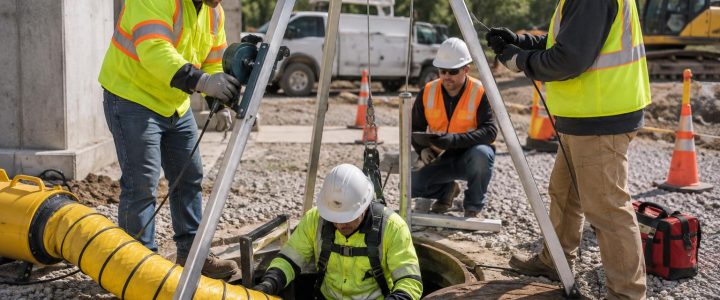
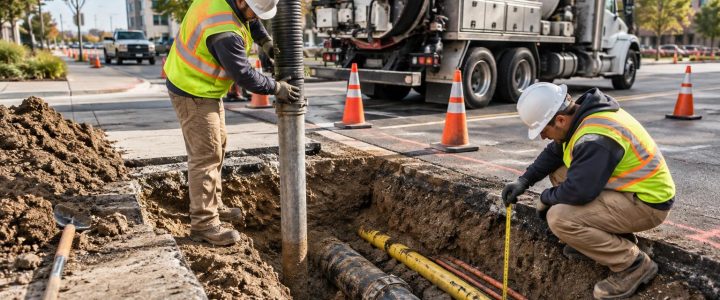
When a storm drain will not carry flow, a sewer route is uncertain, or an older pipe may affect construction, the first question is often: “Can we camera it?” A professional video pipe inspection can be extremely useful, but it does not answer every underground-pipe question by itself.
For contractors, engineers, and facility managers, the key is to separate three related tasks: pipe inspection, pipe locating, and condition assessment. Each produces different information. Selecting the right combination can reduce assumptions before excavation, repair, rehabilitation, construction acceptance, or maintenance planning.
Three services, three different questions
A practical way to plan an underground pipe investigation is to begin with the decision the project team needs to make.
- Video pipe inspection asks: What can be seen inside the accessible pipe?
- Pipe locating asks: Where is the pipe or a feature within it in relation to the ground surface or project control?
- Condition assessment asks: What do the observed conditions mean for maintenance, repair, rehabilitation, acceptance, or further engineering review?
These activities often work well together, but they are not interchangeable. A clear video does not necessarily establish a surveyed pipe alignment. A surface mark does not establish that the inside of the pipe is clear or structurally sound. And an observed crack does not, by video alone, establish its underlying cause or the remaining structural capacity of the pipe.
What professional video pipe inspection can show
Video pipe inspection, often called CCTV pipe inspection or robotic pipe inspection, uses a camera introduced through a manhole, cleanout, inlet, access structure, or other suitable opening. The operator advances the camera through the line while recording visible observations and distances along the inspected reach.
For an accessible storm sewer, sanitary sewer, drain line, culvert, or other pipe, the inspection may help document:
- Visible pipe material and apparent diameter
- Changes in pipe direction, accessible connections, and laterals
- Joint offsets, open joints, separated joints, and displaced sections
- Cracks, fractures, holes, corrosion, deformation, or collapse indicators
- Roots, sediment, grease, debris, and construction material
- Standing water, flow conditions, and visible signs of infiltration
- Connection condition at structures, where visible and reachable
- Obstructions that may explain poor drainage or recurring backups
- Accessible evidence of improper installation or construction damage
A sewer camera inspection is particularly valuable when the project team needs a factual visual record of existing pipe conditions. For example, a contractor may need to identify why a newly constructed drainage system is not draining. An engineer may need to understand whether an aging storm line has visible defects before developing rehabilitation alternatives. A property manager may need documentation of conditions in a line associated with repeated backups.
However, the camera can only document what it can reach and see. Heavy sediment, cloudy water, grease, roots, severe offsets, tight bends, collapsed sections, pipe diameter, and limited access can reduce the usable inspection length or obscure important details. Cleaning, jetting, root removal, or other preparation may be needed before an inspection produces meaningful visual information.
What pipe locating adds to a CCTV inspection
Pipe locating focuses on the horizontal position and, where field conditions and methods allow, the depth or elevation of an underground pipe or an identifiable feature within it. This information may be needed when a pipe crosses proposed excavation, conflicts with a foundation, connects to unknown infrastructure, or must be added to design or record mapping.
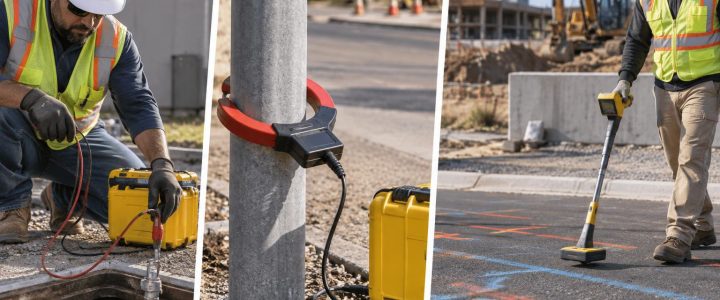
During some CCTV pipe inspections, a sonde or transmitting device associated with the camera can be traced from the surface. This can help establish the approximate route of an accessible line and identify the surface position of a connection, blockage, change in direction, or observed defect.
That is useful field intelligence, but it should not be treated automatically as a complete utility survey. Accuracy depends on the equipment, depth, soil conditions, interference, access, pipe configuration, and the project’s required level of precision. A camera inspection also may not reach the feature that needs to be located.
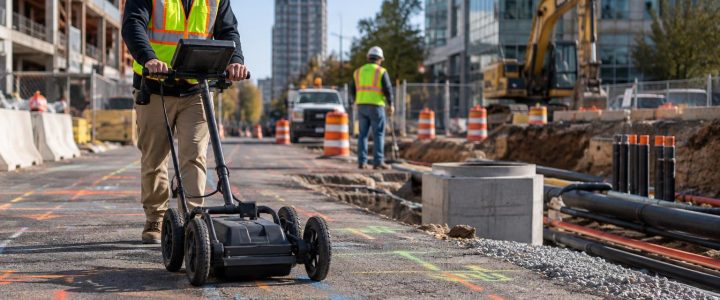
When pipe position matters for design or excavation, the team may need additional work such as surface utility locating, survey control, manhole measurements, record research, subsurface utility engineering, or vacuum excavation to physically verify critical information. Visionary Subsurface Solutions can combine video findings with private utility locating when the project needs more than a visual view inside the pipe.
Examples of when locating is important
- A contractor finds a blocked storm lateral but needs its route before opening pavement.
- An engineer needs to understand whether an existing sewer conflicts with a proposed building addition.
- A site developer needs to identify which inlet or structure connects to an unknown drainage run.
- A municipal project team needs to tie accessible pipe observations to project mapping and field control.
In each case, the inspection may identify a useful target, while locating and surveying provide the information needed to place that target in the site plan.
Condition assessment is more than watching the video
A pipe condition assessment turns field observations into organized information that can support a project decision. The level of assessment should match the purpose of the work.
For a straightforward blockage investigation, the deliverable may identify the accessible route, obstruction location, and visible conditions that affect cleaning or repair planning. For a rehabilitation program, asset-management effort, or construction acceptance review, the project may require a more structured report, consistent defect coding, clear distances, photographs or video clips, and an explanation of inspection limitations.
Standardized methods can help make observations more consistent. For example, NASSCO’s Pipeline Assessment Certification Program, commonly called PACP, provides a standardized system for coding observed conditions in wastewater and stormwater pipelines. LACP applies similar concepts to laterals. A PACP- or LACP-based deliverable should be requested when the project requires that methodology; not every CCTV sewer inspection is automatically a NASSCO-coded assessment.
Standardized coding supports repeatable documentation, but it does not eliminate the need for engineering judgment. A camera may show a crack, fracture, deformation, or open joint. Determining why it occurred, whether it is progressing, whether voids exist outside the pipe, or whether the pipe can carry expected loads may require additional investigation and review by the appropriate project professionals.
How to choose the right scope for common project problems
Unknown storm drain route
Start with an accessible storm drain inspection if there are suitable access points and the goal is to identify visible connections, direction of travel, or interior conditions. Add pipe locating if the team needs the route on the surface, needs to identify a suspected connection point, or needs to plan excavation. Add survey support when design-grade coordinates or elevations are required.
Recurring sanitary sewer backups
A CCTV sewer inspection can help identify visible roots, grease accumulation, debris, offsets, damaged pipe, or other obstructions. It can also show whether the camera is stopped by a condition that needs cleaning or further investigation. If the problem is recurring, the inspection record can help distinguish a one-time blockage from a repeatable condition that may justify repair, rehabilitation, or maintenance changes.
New storm sewer or sanitary sewer construction
For post-installation pipe inspection, the focus is usually quality control and documentation. The inspection may identify construction debris, visible damage, joint issues, missed or defective connections, or other accessible conditions before final acceptance. A camera run should be coordinated with the project specifications, access requirements, cleaning plan, and acceptance process.
Video documentation is especially useful before pavement restoration or final site work makes access and repairs more difficult. If a concern is found, the owner, contractor, and engineer can review the evidence and decide whether cleaning, repair, additional testing, or another inspection is appropriate.
Pre-rehabilitation planning
Before selecting a repair or rehabilitation approach, the team needs to understand whether the pipe is accessible, how far it can be inspected, where visible defects occur, and whether cleaning is necessary. Video inspection can define the observed problem. Locating can tie key features to the site. Engineering analysis may then be needed to select the appropriate repair strategy.
Suspected construction damage near an existing pipe
When heavy equipment, trenching, directional drilling, or other work occurs near an existing pipe, an inspection can document accessible interior conditions. This can be valuable for evaluating visible changes such as cracking, debris entry, deformation, or joint displacement. If the video identifies a concern near a critical crossing, the next step may include targeted locating, survey comparison, pressure testing where appropriate, or physical verification.
What to request in a professional pipe inspection report
Before mobilization, confirm what the report needs to support. A useful underground pipe inspection report commonly includes:
- Project name, inspection date, and inspected asset or reach identification
- Access point information and the stated direction of inspection
- Pipe observations, including visible material and estimated size where identifiable
- Inspection distance and locations of notable observed features
- Video files, still images, or clips tied to the inspection record
- Visible defects, obstructions, connections, and limitations encountered
- Whether cleaning or preparation affected the inspection results
- Locating information, if performed, with the method and stated limitations
- Standardized coding when specifically included in the scope
- Clear notes on segments that could not be inspected or fully evaluated
For projects that require field-to-design integration, discuss file format, naming conventions, coordinate requirements, and survey needs before work begins. This helps make the inspection data easier to use in construction documentation, GIS, asset-management systems, or engineering workflows.
Questions to answer before scheduling CCTV pipe inspection services
- What decision must the inspection support: troubleshooting, acceptance, design, maintenance, or rehabilitation?
- What pipe system is involved: stormwater, sanitary sewer, drainage, culvert, or process piping?
- What access points are available, and are they safe and accessible?
- Is the pipe likely to need cleaning before it can be meaningfully inspected?
- Do you need only interior observations, or do you also need pipe locating and survey information?
- Does the owner or engineer require PACP, LACP, another coding method, or a specific deliverable format?
- Are there schedule constraints before paving, backfill, final acceptance, or repair work?
FAQ: Pipe inspection, locating, and assessment
Can CCTV inspection locate an underground pipe?
It can help establish the route of an accessible pipe, particularly when a traceable camera sonde or similar locating method is used. It does not guarantee a complete or survey-accurate alignment for every pipe. Additional locating, survey work, or physical verification may be needed when location accuracy is critical.
Can a camera determine whether a pipe needs replacement?
A camera can document visible defects and limitations, which can be important inputs to a repair-versus-replacement decision. The structural significance, cause, and appropriate remedy may require engineering review and, in some cases, additional testing or investigation.
Why clean a line before a video pipe inspection?
Sediment, grease, debris, roots, and standing water can block the camera view or prevent the camera from advancing. Cleaning may allow the inspection to reach farther and provide a more reliable view of pipe walls, joints, and connections.
Can every pipe be inspected by camera?
No. Access, diameter, bends, water level, debris, severe defects, pipe configuration, and complete collapse can limit or prevent inspection. A qualified provider should explain these limitations and identify practical next steps when a line cannot be fully inspected.
Plan the investigation around the project decision
The strongest underground-pipe investigation is not simply a camera run or a surface mark. It is a scope built around the information the project needs: visible interior condition, approximate or surveyed location, documented connections, defect coding, acceptance documentation, or a basis for further engineering review.
Visionary Subsurface Solutions provides professional video pipe inspection for stormwater, sanitary sewer, drainage, and other accessible pipe systems throughout Pennsylvania, New Jersey, Delaware, Maryland, New York, and the Washington, D.C. to New York City corridor. Contact our team to discuss the access, documentation, locating, and condition-assessment needs of your project.