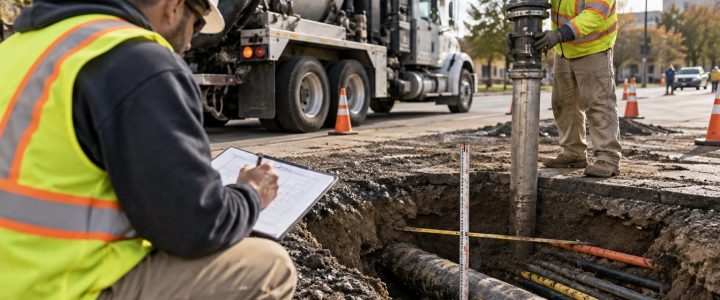
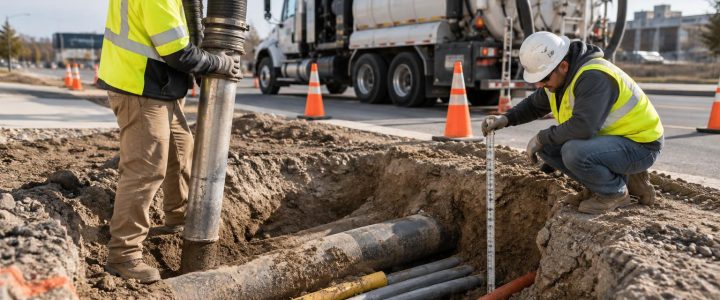
When water ponds in a parking lot, a catch basin stays full after a storm, or an outlet structure is not receiving flow, the visible problem is often only the end result of an underground issue. The cause may be sediment, construction debris, root intrusion, a damaged pipe, a disconnected run, an unknown tie-in, or a problem farther downstream.
A professional commercial storm drain inspection uses a crawler or push camera to document accessible pipe interiors and help the project team narrow down what is happening. For contractors, engineers, municipalities, and facility managers, this information can support maintenance planning, repair design, construction quality control, and drainage investigations.
Video is highly useful, but it is not a substitute for every type of subsurface investigation. A camera can document visible conditions inside an accessible pipe. It does not, by itself, confirm the exact surveyed route, pipe elevation, structural capacity, ownership, or cause of every defect. Those questions may require pipe locating, surveying, cleaning, test holes, flow testing, or engineering review.
Start with the drainage symptom, not a guess
An effective stormwater pipe inspection begins with a clear question. Sending a camera into a system without a defined objective can produce video but not necessarily a useful decision.
Common reasons to investigate include:
- Water remains at an inlet, yard drain, or low point longer than expected.
- A catch basin overflows during rainfall.
- A newly constructed drainage system is not performing as intended.
- Repeated jetting or cleaning has not solved the problem.
- A pavement settlement or sinkhole appears near a drainage route.
- Plans show a pipe system, but field personnel cannot confirm the route or downstream connection.
- A property is being acquired, redeveloped, or rehabilitated and the existing drainage infrastructure is uncertain.
- An owner needs documentation before nearby excavation, utility work, or site construction begins.
For example, a contractor may find that several inlets on a site hold water after rain. The problem could be local to the inlet, but it could also be a downstream restriction, a pipe with standing water, a failed joint that admits soil, or a missing connection. A CCTV inspection helps distinguish among visible possibilities before the team selects a repair approach.
What a CCTV storm drain inspection can show
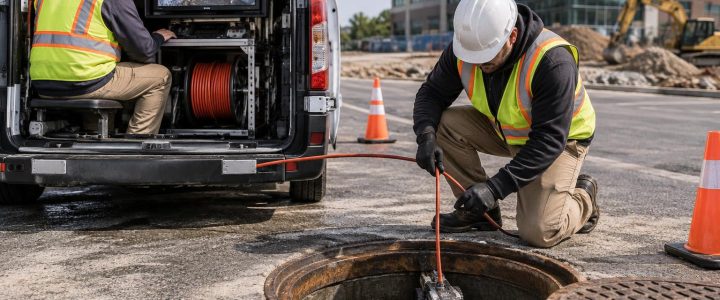
During a storm sewer inspection, an operator introduces a camera through an available access point, such as a manhole, catch basin, cleanout, or other structure. Depending on pipe size, configuration, and access, the inspection may use a push camera, a tractor-style crawler, or robotic pipe inspection equipment with a pan-and-tilt camera.
The recorded video can help document conditions such as:
- Sediment, leaves, trash, construction debris, and other obstructions
- Standing water that limits visibility or suggests a drainage concern
- Cracks, fractures, holes, broken sections, and visible wall damage
- Open, offset, displaced, or defective joints
- Pipe deformation, sagging, separation, or apparent collapse
- Root intrusion at joints or openings
- Visible infiltration, including water entering through joints or defects
- Lateral connections, tie-ins, junctions, and changes in pipe material or diameter
- Evidence of poor installation, such as debris left in a new line or an unsealed connection
These observations can help establish where to clean, where to excavate, what pipe segments need closer evaluation, and whether repair, rehabilitation, or replacement should be considered. The video also creates a time-stamped visual record of the pipe condition at the time of inspection.
Pipe inspection, pipe locating, and condition assessment are different tasks
These services often work together, but they answer different questions.
Pipe inspection documents the inside of an accessible pipe
A camera inspection can show interior features, defects, and connections that are visible from the camera path. It may indicate that the system turns, enters a structure, or connects to another line. However, a camera cannot travel through every system. Tight bends, heavy debris, full flow, severe offsets, inaccessible structures, and collapsed pipe can stop or limit an inspection.
Pipe locating helps establish the route from the surface
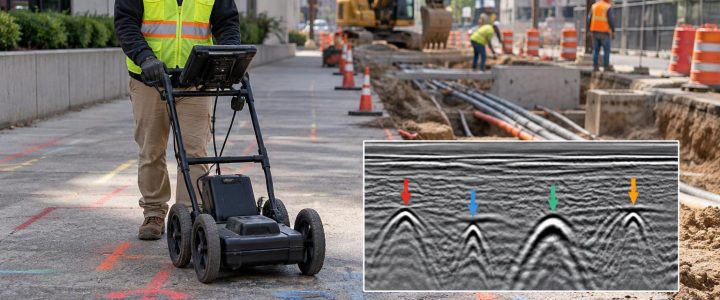
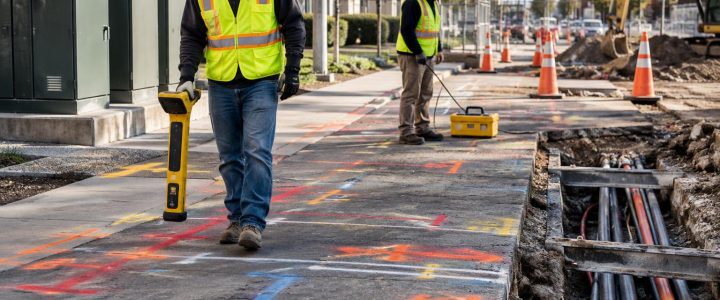
Some camera systems can use a transmitting sonde or other signal source to help locate a point along the pipe from the ground surface. This can be useful for tracing an accessible run or marking a suspected issue for follow-up. Site conditions, pipe depth, access, soil conditions, interference, and equipment configuration can affect the result.
Where a design-ready horizontal and vertical position is needed, the work may also require survey control and a coordinated locating plan. For unknown private utilities or congested project areas, private utility locating can help investigate other underground infrastructure that may affect excavation or repair planning.
Condition assessment turns observations into an organized record
Seeing a crack or open joint is not the same as determining why it occurred or whether it has reduced the pipe’s structural capacity. A pipe inspection report can document what was observed, but the underlying cause and engineering significance may require further review.
For projects that need standardized defect records, the scope may call for a condition assessment using recognized coding methods, such as NASSCO PACP for pipelines and LACP for laterals. That is different from simply collecting video. The project team should define in advance whether it needs general video documentation, a coded assessment, a mapped inventory, or an engineering evaluation.
A practical workflow for investigating a drainage failure
A planned workflow produces more useful results than treating the camera as a last-minute troubleshooting tool.
- Gather available information. Review as-built drawings, drainage plans, maintenance records, prior videos, and reports of when and where ponding occurs. Field notes should identify accessible structures and known discharge points.
- Walk the site. Note inlet elevations, visible flow paths, outlet conditions, pavement distress, standing water, and safety or access constraints. This helps the operator and project manager prioritize pipe segments.
- Define the inspection limits. Identify the lines, structures, and direction of travel to be inspected. Confirm whether the purpose is blockage investigation, condition documentation, post-installation acceptance, route verification, or repair planning.
- Prepare the system when needed. If sediment, debris, grease, roots, or excessive water prevents a meaningful view, cleaning may be necessary before video inspection. Cleaning is not always required, but a camera cannot document pipe wall condition that it cannot see.
- Perform the video pipe inspection. The operator records pipe observations, access points, direction, and relevant distances where field conditions allow. The crew should document limitations, including areas the equipment could not reach.
- Review the findings with the decision in mind. Sort observations into immediate maintenance needs, areas requiring further investigation, and segments that may need repair design or engineering review.
- Verify critical findings before excavation. If excavation is planned at a defect or suspected connection, surface locating, survey, and carefully planned test holes can reduce uncertainty. A camera-based distance is useful context, but it should not be treated as an exact dig location without appropriate verification.
Common findings and what they may mean
Sediment and debris
Sediment often reduces the effective flow area of a storm drain. Construction debris, leaves, trash, or misplaced materials can also obstruct a line. Video can show the approximate extent of a visible blockage, but cleaning may be needed to determine what lies beneath it and whether the pipe wall is damaged.
Open or displaced joints
Visible joint separation or displacement can allow soil or water to move where it should not. The observation may help explain sediment entry, infiltration, or a recurring blockage. It does not, by itself, establish whether settlement, installation error, traffic loading, or another condition caused the defect.
Cracks, holes, and broken pipe
A camera can record visible damage and help identify a location for further evaluation. The project team may then need engineering input, surface observations, or excavation to determine repair limits and whether surrounding soils have been affected.
Roots and recurring restrictions
Roots may enter through joints, cracks, or openings. Removing roots can restore flow, but a repeat issue may indicate that a joint or defect still needs attention. Video before and after cleaning can help document the condition and support maintenance decisions.
Standing water and low-flow concerns
Standing water can reduce visibility and may indicate a low area, obstruction, outlet restriction, or flow condition. It should be interpreted alongside pipe direction, elevations, rainfall history, and the broader drainage layout. CCTV alone does not establish pipe slope or hydraulic performance with the precision needed for design.
Why post-installation storm sewer inspection matters
New storm sewer is not automatically free of problems. Backfill operations, equipment traffic, incomplete cleaning, damaged pipe, displaced joints, and debris can affect a system before final acceptance. A post-installation pipe inspection gives the contractor, engineer, and owner an opportunity to document accessible conditions while the project is still active.
For construction acceptance, a useful inspection scope may include:
- Identifying the pipe runs, structures, and direction of inspection
- Confirming that the system has been cleaned enough for a meaningful visual review
- Documenting visible debris, damage, joints, and connections
- Recording inaccessible segments and inspection limitations
- Providing video files and an organized observation log
- Coordinating any required defect coding or acceptance criteria with the engineer or owner before field work begins
This documentation can help resolve questions before demobilization and before pavement, landscaping, or other finished work makes access more difficult.
What to request from a professional inspection provider
When requesting stormwater inspection services, provide the project location, available plans, pipe sizes if known, structure types, suspected problem areas, and the purpose of the investigation. It is also helpful to state whether the team needs general video, pipe route support, a formal condition assessment, or post-construction documentation.
A professional deliverable may include inspection video, still images, an observation summary, pipe and structure references, distance information where available, and notes on access or visibility limitations. For complex manholes and structures, 3D manhole LiDAR scanning may provide additional geometric documentation that standard pipe video does not provide.
Frequently asked questions
Can CCTV locate underground storm drains?
It can help establish the route of an accessible pipe, especially when inspection equipment includes a locatable signal source. It should not be assumed to provide a precise surveyed alignment or elevation on its own. Surveying, surface locating, and other investigation may be appropriate when excavation or design decisions depend on exact positions.
Can a camera inspect a blocked or collapsed storm pipe?
Only to the point that the camera can safely travel and obtain a usable view. Heavy sediment, debris, water, offsets, tight bends, and collapse can limit access. Cleaning or another investigation method may be needed before the full condition can be understood.
Does video inspection prove that a pipe is structurally sound?
No. Video can document visible interior conditions and defects. Determining structural significance, service life, hydraulic performance, or repair design may require additional engineering analysis and field verification.
Plan the inspection around the project decision
A commercial storm drain inspection is most valuable when it is tied to a practical decision: clear a blockage, verify a new installation, document existing conditions, define repair limits, or investigate a drainage failure. Clear objectives, proper preparation, and honest documentation of limitations help the video become useful project information rather than just footage.
Visionary Subsurface Solutions provides professional video pipe inspection for stormwater, sanitary sewer, drainage, and other accessible piping systems throughout Pennsylvania, New Jersey, Delaware, Maryland, New York, and the Washington, D.C. to New York City corridor. Contact our team to discuss the access conditions, inspection goals, and documentation needs for your project.