Recurring sanitary sewer backups are rarely solved by guessing. Clearing a blockage may restore flow for a time, but it does not necessarily explain why the line blocked, where the restriction is located, or whether a pipe defect is contributing to the problem.
A professional CCTV sewer inspection gives project teams visual information from inside an accessible pipe. For contractors, facility managers, engineers, and property owners, that information can help separate a one-time obstruction from a repeat condition that needs repair, rehabilitation, cleaning, or further investigation.
Video inspection is not a substitute for engineering analysis, surveying, or excavation when those services are needed. It is, however, a practical starting point for investigating recurring commercial sewer backups and documenting what can actually be observed inside the system.
Why a sewer line may keep backing up after it is cleared
A sewer cleaning crew may remove roots, grease, wipes, sediment, or other material that is blocking flow. If the same line backs up again, the underlying issue may be more than the material removed that day.
Common conditions observed during a sewer camera inspection include:
- Root intrusion entering through joints, service connections, or damaged pipe walls
- Accumulated grease, scale, sediment, or debris that reduces the usable pipe opening
- Offset, open, displaced, or defective joints that catch solids or admit roots
- Cracks, fractures, holes, or sections with visible deformation
- A sag or low area where solids appear to collect
- Construction debris, grout, or other foreign material in a newer line
- Defective or poorly understood lateral connections
- A pipe that is partially collapsed or too obstructed for the camera to continue
Seeing one of these conditions does not automatically establish its cause or structural significance. For example, a camera may show a crack or a low area, but determining whether it resulted from settlement, traffic loading, installation issues, ground movement, or another condition may require records review, survey data, cleaning, test holes, or engineering evaluation.
What CCTV sewer inspection can show during a backup investigation
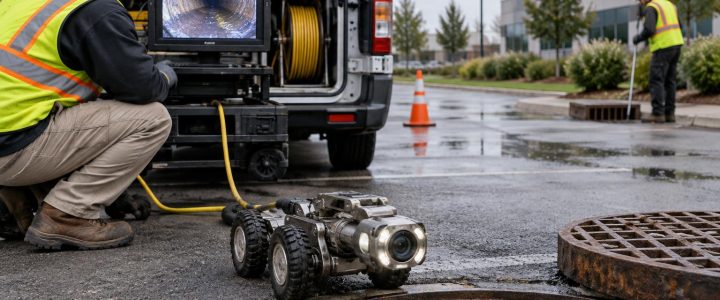
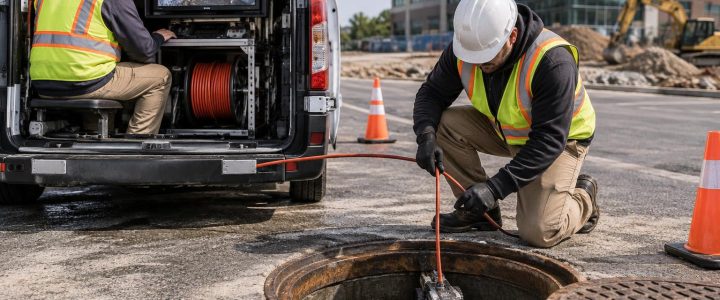
During a video sewer inspection, a camera is introduced through a suitable cleanout, manhole, vault, or other access point. The camera records the interior of the accessible pipe as it travels through the line. Depending on access, pipe size, configuration, flow conditions, and the equipment used, the inspection can document visible pipe features and conditions.
For a recurring-backup investigation, the inspection may help a team identify:
- The apparent location and extent of a blockage or restriction
- Changes in pipe condition along the inspected run
- Visible roots, grease, sediment, debris, or mineral buildup
- Connections, laterals, junctions, and transitions between pipe sections
- Evidence of joint displacement, openings, fractures, holes, or deformation
- Whether the camera can pass through the pipe or is stopped by an obstruction
- Features that help compare the observed system with available utility drawings
This is especially useful when a property has incomplete as-builts, several building additions, unknown private laterals, or a history of repeated maintenance calls with no clear repair plan.
Pipe inspection, pipe locating, and condition assessment are different tasks
These services often support the same project, but they answer different questions.
Video pipe inspection documents interior observations
A CCTV inspection can show the interior route of an accessible pipe, visible connections, and observable defects or obstructions. It may also provide useful clues about where a condition lies in relation to an access point, based on the inspection equipment and recorded distance.
Pipe locating establishes an above-ground route
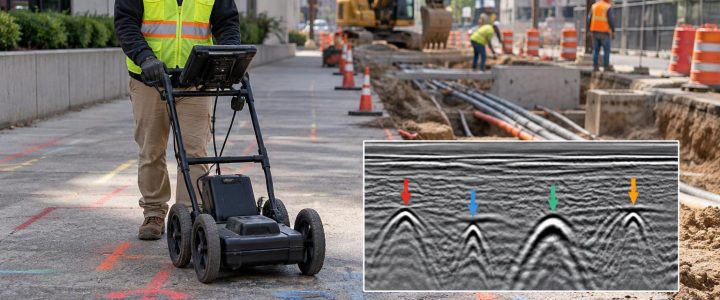
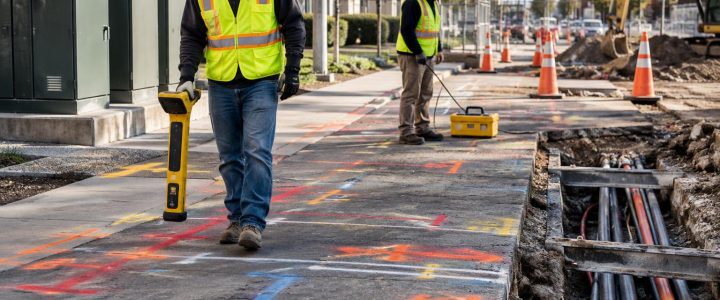
A camera inspection alone does not always provide a precise horizontal or vertical pipe location. In many situations, a sonde or transmitting camera can be traced from the surface to help establish an approximate route. Survey control, access limitations, signal interference, pipe depth, and site conditions all affect the result. If design or excavation decisions depend on reliable coordinates or depth, additional locating and survey work may be appropriate.
For projects involving private laterals, site piping, or unknown connections, private utility locating can help investigate utilities beyond the limits of typical public utility markings.
Condition assessment turns observations into useful records
A condition assessment organizes inspection observations so a team can compare pipe segments, prioritize maintenance, and communicate repair needs. Standardized methods such as NASSCO’s Pipeline Assessment and Certification Program (PACP) and Lateral Assessment and Certification Program (LACP) use established terminology and coding concepts for wastewater pipe observations. Not every inspection is a PACP or LACP assessment, so project teams should confirm the requested reporting method before work begins.
Standardized coding can make it easier to distinguish a visible observation from a conclusion about repair priority. Repair design and structural decisions should still account for pipe material, depth, soil conditions, loading, flow needs, access, and other project-specific factors.
A practical workflow for investigating recurring sewer backups
The most useful inspections begin with a clear problem statement. A crew needs to know which areas back up, how often it happens, what maintenance has already been performed, and which access points are available.
- Define the affected area. Identify the fixtures, building areas, manholes, cleanouts, or site drains connected to the problem. Note whether the event occurs during peak building use, wet weather, or after a known operational change.
- Collect available information. Gather utility plans, record drawings, prior jetting reports, maintenance logs, tenant reports, and photographs. Records may be incomplete, but they provide a starting point.
- Prepare the pipe for meaningful viewing. Heavy debris, grease, standing water, roots, or sediment can conceal the pipe wall. Cleaning may be needed before CCTV inspection can produce useful visual results.
- Inspect from appropriate access points. The inspection approach should account for pipe size, direction of flow, bends, junctions, lateral entries, and safe access requirements.
- Review the footage and observations. Look for the restriction itself, contributing defects, and changes in condition upstream and downstream of the trouble area.
- Decide what must be verified next. A repair may be supported by video evidence alone in some cases. In others, locating, surveying, smoke testing, dye testing, vacuum excavation, or engineering review may be needed before selecting a repair.
When cleaning should happen before CCTV inspection
Cleaning and inspection are complementary, not competing, services. A camera cannot provide a meaningful wall-to-wall view through a pipe that is fully packed with debris or has a high water level. In those conditions, the inspection may still document the blockage and the point where access ends, but it may not reveal the pipe condition beyond it.
Pre-inspection cleaning is commonly considered when there is:
- Heavy sediment in storm or sanitary lines
- Grease accumulation from food service operations
- Known root intrusion
- Debris following construction or repairs
- Repeated blockages that prevent camera passage
- Standing water that obscures the pipe invert and wall
The right sequence depends on the investigation. If the immediate goal is to document an active blockage before it is disturbed, an initial camera attempt may be useful. If the goal is to assess the full pipe condition, cleaning first may provide a much more complete inspection.
What a professional sewer camera inspection report should provide
A usable report should help a project manager or engineer understand what was inspected, what could not be inspected, and what was observed. The report should not overstate conclusions beyond the available evidence.
Ask whether the deliverable will include:
- Inspection video associated with the inspected pipe run
- Project, access point, and pipe segment identification
- Observed pipe size and material when they can be reasonably identified or are supplied by project records
- Recorded distance references, with the method and limitations understood
- Still images of notable observations when appropriate
- Descriptions or standardized codes for visible defects and features, if requested
- Notes on inaccessible segments, obstructions, poor visibility, or other inspection limitations
- A clear distinction between observed conditions and recommendations requiring further professional evaluation
For larger municipal, industrial, or campus systems, consistent reporting also supports asset-management workflows. It can give owners a repeatable record of what was observed in each accessible segment and help prioritize cleaning, repair, rehabilitation, or further investigation.
Limits that matter on active projects
CCTV inspection is highly useful, but it has practical limits. It cannot reliably inspect pipe segments that are inaccessible, completely collapsed, severely blocked, or beyond restrictive bends and configurations. Pipe diameter, access opening size, water level, flow, sediment, debris, pipe material, and the condition of the line all affect what can be seen.
Likewise, video may reveal infiltration entering at a joint or defect, but it does not by itself quantify the source, rate, or full impact of that water. A visible defect can support a repair decision, but it does not automatically establish the condition of the surrounding soil or the pipe’s remaining structural capacity.
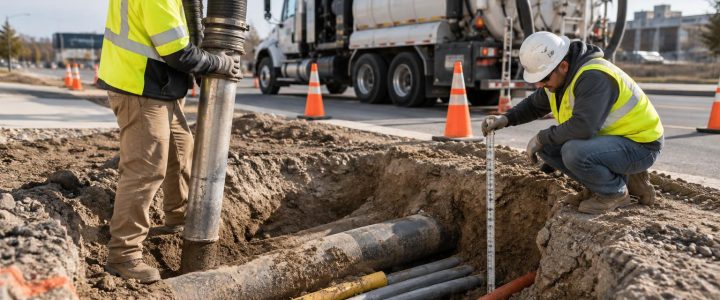
When a finding needs to be tied to a proposed excavation, design elevation, or exact surface coordinate, consider combining the inspection with locating, survey control, or selective vacuum excavation and test holes. That added verification can reduce uncertainty before crews mobilize for repair.
FAQ: CCTV sewer inspection for recurring backups
Can a sewer camera find the exact location of a blockage?
It can identify an observed blockage or restriction within an inspected run and provide distance information from an access point. Exact surface location and depth may require a traceable sonde, surface locating, survey support, or verification by excavation, depending on the required accuracy and field conditions.
Can CCTV inspection tell whether a pipe needs replacement?
Video can document visible defects and obstructions that inform repair-versus-replacement decisions. The final decision should consider the defect type and extent, pipe material, hydraulic needs, site access, future loading, repair history, and engineering requirements.
Will a camera inspect every part of a sewer system?
Not necessarily. Access points, pipe size, bends, debris, active flow, collapsed areas, and obstructions can limit camera travel and visibility. A professional report should identify the portions that were inspected and any portions that could not be reached or viewed adequately.
Is a CCTV sewer inspection useful after a backup has been cleared?
Yes. Once the line is cleaned enough for the camera to pass, inspection can help identify conditions that may have contributed to the blockage and establish a documented baseline for maintenance or repair planning.
Make the next sewer repair decision with better information
Recurring sewer backups can disrupt operations, damage finished spaces, and create difficult decisions under time pressure. A professional video pipe inspection helps replace assumptions with documented observations of the accessible system. It can show where further cleaning is needed, where a repair investigation should focus, and what information still needs to be verified before construction begins.
Visionary Subsurface Solutions provides video pipe inspection for sanitary sewer, stormwater, drainage, and accessible underground pipe systems throughout Pennsylvania, New Jersey, Delaware, Maryland, New York, and the Washington, D.C. to New York City corridor. Contact our team to discuss the access available, the history of the problem, and the inspection information your project needs.