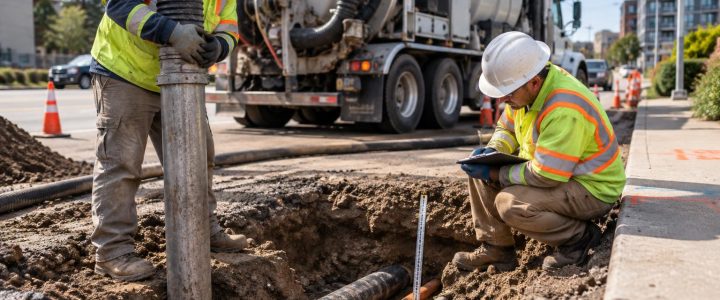
Construction closeout is often the first time an owner receives a complete picture of a new underground pipe system. Plans, material tickets, and as-built markups are valuable, but they may not show what is inside a storm sewer, sanitary sewer, or site drainage line after backfill and paving are complete.
A professional CCTV sewer inspection can help fill that gap. It provides a visual record of accessible pipe interiors and can identify conditions that may need review before final acceptance, such as construction debris, displaced joints, open connections, visible damage, standing water, or incomplete cleaning. For contractors, engineers, and owners, the real value is not simply receiving video files. It is receiving organized information that can be matched to structures, pipe segments, project requirements, and closeout decisions.
This article explains how to plan a construction-closeout pipe inspection and what a useful inspection package should include.
Why pipe inspection belongs in the closeout process
New pipe is not automatically defect-free pipe. Material can be damaged during handling, installation, compaction, later construction activities, or connection work. Debris may enter an open line. A connection can appear correct from the surface but show an internal offset or intrusion on video. These observations do not, by themselves, establish the cause or engineering significance of every condition. They do give the project team evidence to review before a concern becomes a maintenance issue.
For construction acceptance, video pipe inspection is commonly used to support several practical goals:
- Document the observable interior condition of new storm sewer, sanitary sewer, drainage, or culvert segments.
- Confirm that a camera can travel between identified access points where access and pipe conditions allow.
- Identify visible debris, sediment, grout, concrete, roots, or other obstructions that may affect flow or future maintenance.
- Review visible joints, laterals, taps, transitions, and manhole connections.
- Help establish whether reported punch-list items are confined to one segment or appear in several locations.
- Create a baseline record for the owner’s operations, maintenance, and asset-management files.
The inspection should be coordinated with the contract documents, the engineer’s acceptance requirements, and the owner’s preferences. A camera survey is one piece of quality assurance. It does not replace required leakage testing, deflection testing, mandrel testing, air testing, pressure testing, surveying, or engineering review when those items apply to the project.
What a construction-closeout CCTV inspection can show
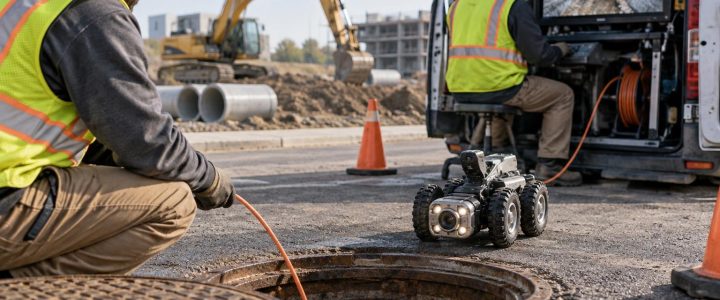
A push camera or robotic crawler records the interior of an accessible pipe. The equipment selection depends on pipe diameter, access structures, bends, flow conditions, and the distance to be inspected. A crawler-based system may be appropriate for many larger gravity pipe segments, while smaller lines may require a push camera or other specialized approach.
When visibility and access are adequate, the inspection may document observable conditions such as:
- Cracks, fractures, holes, breaks, or visible wall damage.
- Joint separation, offset joints, open joints, and connection irregularities.
- Visible deformation, sagging indications, or partial collapse.
- Construction materials, soil, trash, sediment, or standing water.
- Protruding laterals, service connections, taps, or intruding materials.
- Root intrusion in existing lines or at tie-in areas.
- Pipe material changes, fittings, bends, transitions, and accessible branches.
- Features that may warrant follow-up, including signs consistent with possible infiltration or leakage paths.
Video is especially useful because it preserves context. A written note stating “debris observed” is less helpful than a record showing the debris, the direction of travel, the pipe segment, the distance reference, and the nearby upstream or downstream structure.
What video alone cannot establish
Inspection video has important limits. A camera may reveal a visible crack, but it does not independently determine the crack’s cause, structural severity, or remaining service life. Likewise, a camera may show water entering through a joint, but additional investigation may be needed to determine whether the source is groundwater, a nearby connection, surface inflow, or another condition.
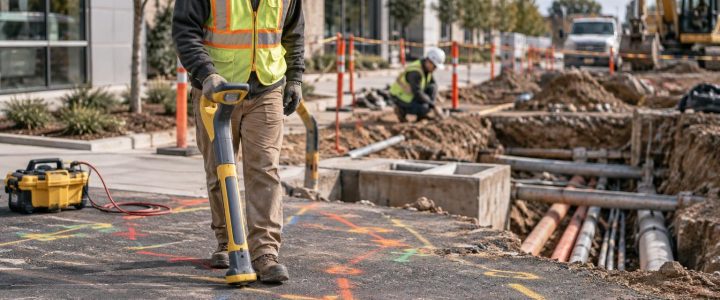
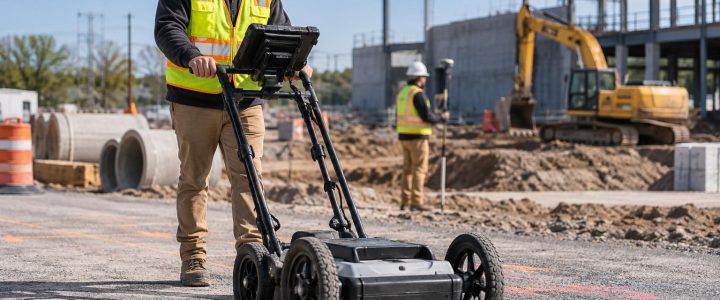
Video also does not automatically provide a precise surveyed horizontal alignment or invert elevation. If route, depth, or coordinates are needed for design or record drawings, the work may need pipe locating, surface survey control, manhole measurements, or other verification. Visionary Subsurface Solutions can coordinate video findings with private utility locating when a project needs more than an interior visual record.
Plan the inspection before final paving and demobilization
The best time to discuss closeout inspection is before the work reaches final acceptance. Waiting until crews have demobilized can make correction work slower and more expensive. Early planning also allows the project team to identify access points, required cleaning, traffic-control needs, expected pipe sizes, and the naming convention for deliverables.
Start with a segment list
Build a simple list of the pipe runs that need inspection. For each segment, identify the upstream and downstream structure, expected pipe diameter and material, approximate length, and whether the system is storm, sanitary, or another drainage service. This list helps prevent gaps and gives the inspection crew a consistent way to label files.
For a commercial site, a segment might be labeled from an inlet to a junction structure, or from Manhole S-4 to Manhole S-5. The same identifiers should appear, where possible, on plans, field logs, video overlays, and the final report.
Confirm cleaning and access conditions
A camera can only document what it can see and reach. Heavy sediment, muddy water, debris, grease, roots, tight bends, blocked access structures, or a fully obstructed pipe can limit the result. Cleaning may be needed before inspection, particularly after construction when aggregate, soil, concrete residue, or packaging materials may have entered the system.
Cleaning should not be treated as an afterthought. If the project objective is acceptance documentation, the team needs enough visibility to evaluate the pipe interior meaningfully. When an obstruction remains, the report should identify the limit of inspection rather than implying that the entire segment was evaluated.
Agree on timing and sequence
Closeout inspections are often most useful after the system is substantially complete and cleaned, but before final acceptance releases the contractor from correction responsibilities. The correct sequence depends on the project. Some teams inspect before final paving; others inspect after all utility crossings, landscaping, and connection work are complete.
If damage is suspected from a later activity, a targeted reinspection can document the affected segment. For complex projects, interim inspections may be useful at key milestones rather than relying on a single final survey.
How to turn inspection findings into a workable punch list
Video becomes more useful when the observations are organized into an action process. Not every visible feature requires repair. Some conditions may be expected elements of the installed system, while others may require review against specifications, design intent, or owner standards.
A practical workflow is:
- Review the segment coverage. Confirm which lines were inspected, which lines were inaccessible, and where an inspection stopped.
- Review observations by location. Tie each item to a structure-to-structure segment, direction of travel, and distance reference when available.
- Compare with project requirements. The engineer, owner, or designated reviewer should determine whether an observation meets the project’s acceptance criteria.
- Assign a follow-up action. Actions may include cleaning, repair, additional testing, locating, surveying, excavation, or no action with documentation.
- Reinspect repairs where appropriate. A post-repair video provides a clear record of the accessible interior condition after corrective work.
- Preserve the final records. Deliver the final videos, logs, reports, and file naming information in a format the owner can retrieve later.
This approach separates observation from decision-making. The inspection provider documents what is visible. The responsible project parties evaluate compliance, cause, risk, and the appropriate remedy.
What to request in a professional pipe inspection deliverable
A useful closeout package should let someone who was not on site understand what was inspected. At a minimum, ask how the provider will identify each run and how inspection limits will be reported.
Depending on the project and scope, deliverables may include:
- Video files labeled by pipe segment or structure identifiers.
- A field log or report with upstream and downstream access points, travel direction, pipe size, and material when known or provided by the client.
- Date, project name, and inspection operator information.
- Distance references and observations recorded during the run, where equipment and conditions permit.
- Still images of significant visible features.
- A summary of segments that could not be completed and the reason, such as blockage, debris, access limitations, or equipment reach.
- Recommendations for additional investigation when the observed condition cannot be resolved from video alone.
For owners managing larger collection systems, standardized coding can improve consistency across many inspections. NASSCO’s Pipeline Assessment Certification Program, commonly called PACP, uses a standardized framework for documenting observed pipeline defects. Its companion Lateral Assessment Certification Program, or LACP, addresses laterals. A project should not assume that every CCTV survey is a PACP or LACP assessment; confirm the requested methodology, coding requirements, and qualifications before work begins.
NASSCO describes PACP and LACP as standardized condition-assessment programs, while the U.S. Environmental Protection Agency identifies condition assessment and system information as important parts of collection-system management. These frameworks can be helpful where the owner needs repeatable data for rehabilitation planning or asset management, rather than only a final construction video. Learn more about PACP from NASSCO and review the EPA’s collection-system management resources when developing owner-level inspection programs.
When additional investigation is appropriate
CCTV inspection can narrow the question, but some findings call for a different method. For example, a visible pipe offset may require engineering review or excavation to confirm its extent. An uncertain pipe route may need locating and survey support. A suspected void, crossing conflict, or unknown connection may require subsurface investigation.
Potential follow-up services can include survey, cleaning, flow testing, pressure or leakage testing, smoke or dye testing where appropriate, physical exposure, or vacuum excavation and test holes. The right next step depends on the project question. The goal is to collect enough reliable information to make a responsible decision, not to force every problem into a camera-only solution.
FAQ: CCTV pipe inspection for construction acceptance
Does a successful camera run mean the pipe installation is accepted?
No. A camera run can document accessible interior conditions and identify visible concerns, but acceptance depends on the contract documents, required tests, engineer or owner review, and any applicable agency requirements.
Can a sewer camera locate a pipe accurately for an as-built drawing?
A camera can help trace an accessible pipe route and identify features such as structures and branches. Precise horizontal or vertical locations generally require additional locating and survey methods. The needed accuracy should be defined before the work begins.
Can CCTV inspection find every defect?
No. Visibility can be limited by water, sediment, debris, pipe geometry, access, obstructions, and camera reach. External pipe conditions, surrounding soil conditions, and defects hidden by deposits may not be visible. Reports should clearly state any inspection limitations.
Why inspect a newly installed storm sewer if it has not had a problem?
Closeout inspection creates a baseline record and may identify correctable installation or cleaning issues before turnover. It can also help the owner distinguish pre-existing conditions from future maintenance concerns.
Make pipe closeout records useful long after turnover
A final CCTV sewer inspection is most valuable when it is planned as part of the project record, not treated as a last-minute video request. Clear segment naming, cleaned lines, documented limits, and a disciplined review process give contractors, engineers, and owners a better basis for acceptance and future maintenance decisions.
Visionary Subsurface Solutions provides professional video pipe inspection for stormwater, sanitary sewer, drainage, and accessible underground piping systems throughout Pennsylvania, New Jersey, Delaware, Maryland, New York, and the Washington, D.C. to New York City corridor. Contact our team to discuss the inspection scope, access conditions, documentation needs, and project-closeout goals for your site.