Overhead power lines can be easy to overlook because they are above the main work area. Yet they can create a serious hazard when dump trucks raise beds, excavators swing, telehandlers lift, cranes set materials, or workers carry long conductive items.
The safest approach is to treat every overhead line as energized unless the utility owner has confirmed otherwise. A line does not have to be touched directly to create a dangerous event. Electricity can arc through air when equipment gets too close, especially at higher voltages. Contact can energize the equipment, the ground around it, nearby fencing, and other conductive paths.
Good overhead power line safety starts before equipment arrives. It requires a site-specific plan that keeps people and machines away from the hazard rather than asking workers to react at the last second.
Why overhead line incidents happen
Most overhead line incidents involve routine work activities, not unusual tasks. A crew may be focused on production, traffic, an unstable load, a tight delivery window, or another immediate concern. The line is present, but no one has established a clear plan for working around it.
Common exposure situations include:
- Dump trucks raising beds beneath or near a service line.
- Excavators, backhoes, and loaders traveling with a boom or bucket elevated.
- Telehandlers placing materials near building service lines.
- Cranes, concrete pump booms, and aerial lifts operating within the line area.
- Workers carrying rebar, pipe, ladders, scaffold components, or other long materials.
- Deliveries routed beneath lines without checking vehicle height or raised-bed clearance.
- Temporary lighting, signs, fencing, or scaffold erected near energized conductors.
These events are often preventable. The key is to identify the line hazard during planning, define a protected work area, and adjust the work method before a piece of equipment is in motion.
Know the difference between a clearance rule and a safe work plan
Clearance is important, but it is only one part of construction site safety. Workers need to know where equipment will travel, where it will load or dump, where materials will be staged, and who has authority to stop movement when conditions change.
OSHA construction standards generally require equipment to stay at least 10 feet from energized overhead lines rated 50 kilovolts or less. Required distance increases for higher-voltage lines. The applicable rule can depend on the equipment, task, voltage, and work conditions. Crane operations have additional, specific requirements.
Do not estimate voltage by looking at the line. Do not assume a line is low voltage because it is near a building, or that it is abandoned because it appears unused. Confirm information with the utility owner and review the applicable requirements with the competent person, qualified electrical personnel, and project safety leadership as needed.
For current regulatory guidance, review OSHA’s construction equipment requirements and OSHA’s overhead power line safety guidance. The National Institute for Occupational Safety and Health also emphasizes planning work to prevent contact with overhead electrical lines.
Before You Start: overhead power line safety checklist
Use this short checklist in the pre-task plan, daily huddle, or equipment briefing. It is most effective when the operator, foreman, spotter, and affected trades take part.
- Walk the work area and identify all overhead lines, poles, guy wires, service drops, and line crossings.
- Identify work that could increase equipment height, including dumping, lifting, swinging, boom extension, and raising forks.
- Determine the highest point of each machine in its working position, not just its travel position.
- Identify line voltage and required clearance through the utility owner or other reliable project information. Do not rely on visual assumptions.
- Mark a no-go area on the ground where practical. Use barriers, signage, physical limits, or a revised traffic route.
- Choose a loading, dumping, or staging location outside the line hazard area.
- Discuss visibility limits, blind spots, weather, night work, and changing ground conditions.
- Assign a trained spotter only when a spotter is part of a defined communication plan. Establish signals before work starts.
- Review what the operator and ground crew will do if equipment contacts a line.
- Stop and reassess if the task, equipment, weather, or traffic pattern changes.
Use the hierarchy of controls
PPE is necessary for many construction tasks, but it does not make an equipment-to-line contact safe. The better approach is to control the hazard at its source whenever possible.
Eliminate the exposure
The strongest control is to remove the electrical hazard from the work area. This may mean arranging for the utility owner to de-energize and ground the line, relocating the work, or changing the project sequence. Only the utility owner or properly authorized qualified personnel should make decisions about de-energizing or grounding utility lines.
Use engineering and physical controls
When work must occur near lines, physical planning tools can reduce the chance of a wrong move. Examples include height-limiting devices where appropriate, barricaded exclusion zones, designated haul roads, restricted dumping zones, and material staging away from the line corridor.
Be careful with warning devices and proximity alarms. They can be helpful as an added layer, but they do not replace required clearances, trained judgment, or a controlled work plan.
Set administrative controls that crews can follow
Administrative controls include the pre-task plan, equipment routing, a defined spotter role, documented communication signals, restricted access, and supervision. These controls work only when they are specific. “Watch the lines” is not a workable plan. “Dump trucks use the south haul road, stop at the marked point, and never raise beds in the loading lane” is more useful.
Use PPE for the hazards it can address
Hard hats, high-visibility apparel, and other required PPE remain important on an active jobsite. However, ordinary construction PPE is not a substitute for distance from an energized line. Electrical protective equipment and work practices must be selected by qualified personnel for the specific electrical exposure.
Managing mobile equipment near overhead lines
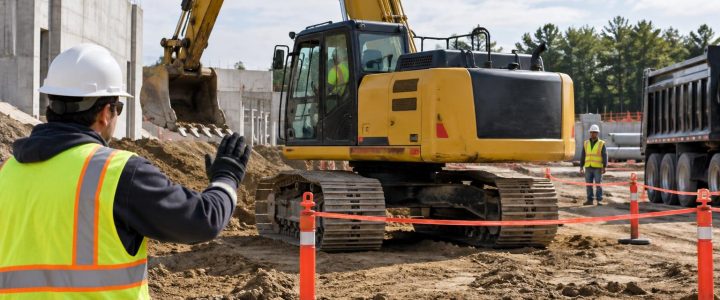
Equipment movement is a frequent source of exposure because machines change shape as they work. A truck may enter an area at a safe height, then create a hazard when its bed rises. An excavator’s boom may clear a line while traveling but move toward it during a swing. A telehandler’s forks may be safe at ground level and unsafe when raised.
Plan travel routes and work positions
Route equipment so operators do not need to pass beneath or beside lines when another route is available. Consider the full envelope of movement: boom height, raised bed height, fork height, load length, swing radius, and uneven terrain that can tilt a machine toward the line.
Keep haul routes simple. A sharp turn, soft shoulder, stockpile, or congested laydown area can force equipment into a line corridor that looked avoidable on paper.
Do not make the spotter the only control
A spotter can help an operator maintain awareness, particularly where sightlines are limited. But a spotter should not be the sole barrier between a machine and an energized line. The spotter must have a safe location, a direct view of both the equipment and the hazard, reliable communication with the operator, and clear authority to stop work.
If the operator loses sight of the spotter or cannot understand the signal, equipment movement should stop until communication is restored.
Control long and elevated materials
Pipe, rebar, ladders, scaffold frames, roofing materials, and metal conduit can create an overhead electrical exposure even when no large machine is present. Plan carrying paths and storage locations. Keep long materials low and away from line corridors. Do not lift, move, or assemble materials where they could enter the required clearance area.
If equipment contacts an overhead power line
Every crew that works near lines should discuss this response before starting. In general, the operator should remain inside the equipment cab if it is safe to do so. The operator should warn others to stay away, avoid touching the machine and the ground at the same time, and have emergency services and the utility owner contacted.
Ground personnel should stay clear of the machine, its load, and the surrounding area. They should not approach to help, touch the equipment, or try to move a line. The ground may be energized near the contact point, creating step-potential risk.
If staying in the cab creates an immediate danger, such as fire, the operator may need to exit. That is an emergency action: the operator should jump clear without touching the equipment and ground at the same time, then move away using short shuffling steps while keeping both feet close together. Workers should receive site-specific emergency training rather than trying to learn this procedure during an incident.
Do not resume work until the utility owner or other authorized qualified party confirms that the hazard has been addressed and the area is safe.
Common mistakes to avoid
- Assuming a line is insulated. Covering or insulation may not protect against equipment contact, and its condition may be unknown.
- Measuring only machine travel height. Evaluate the machine in its highest and widest working configuration.
- Using cones as the only boundary. Cones may be moved, missed, or ignored during a busy shift. Use a defined work plan and physical controls where feasible.
- Letting delivery drivers improvise. Include drivers in the site traffic and overhead-hazard briefing before they enter the work area.
- Continuing after conditions change. Wind, poor visibility, a new stockpile, a different machine, or a revised route can invalidate the original plan.
- Trying to help after contact. Approaching energized equipment can turn one incident into multiple injuries.
Questions supervisors should ask during the daily huddle
- What equipment or materials could reach the line area today?
- Where will trucks load, turn, and raise their beds?
- Has the work area changed since the last shift?
- What is the planned route for deliveries and mobile equipment?
- Who is the designated spotter, and what signals will be used?
- Where is the no-go area, and does every affected worker understand it?
- What is the emergency response if a line is contacted?
Make overhead hazards part of everyday jobsite safety
Overhead power line safety is not limited to electrical contractors. It is a planning issue for excavation crews, concrete contractors, material suppliers, sitework teams, steel crews, roofing crews, and anyone managing mobile equipment. The safest jobsites identify the hazard early, make the safe route and work position obvious, and give operators the authority to stop when the plan no longer fits field conditions.
Safety decisions should always reflect site-specific conditions, applicable requirements, employer policies, equipment manufacturer instructions, and the judgment of qualified professionals. For projects where overhead hazards overlap with excavation, new utility installation, or congested site conditions, contact Visionary Subsurface Solutions to discuss a practical investigation and work-planning approach for your project.