Overhead power lines are easy to see, but that does not make them easy to manage. A dump truck bed, excavator boom, crane load, ladder, scaffold component, or long piece of conduit can enter the danger zone quickly. Electrical contact can seriously injure or kill workers, damage equipment, and shut down a project.
Effective overhead power line safety starts before equipment arrives. The goal is not simply to remind workers to “be careful.” It is to identify lines, understand what work could bring people or equipment close to them, and establish physical and operational controls that keep the work outside the hazard area.
This guide covers practical construction site safety steps for work near energized overhead lines. Site-specific conditions, utility-owner requirements, equipment manufacturer instructions, employer policies, and applicable regulations may require additional controls.
Why overhead power lines create a construction hazard
Electricity can travel through equipment, rigging, materials, tools, and the ground. Direct contact is not the only concern. Electricity can arc through air when equipment or a load gets close enough to an energized line. The required distance depends on factors such as line voltage and the work being performed.
Common jobsite activities that create overhead-line exposure include:
- Operating excavators, backhoes, loaders, telehandlers, forklifts, and dump trucks
- Setting trusses, steel, precast, pipe, poles, signs, or structural components
- Using mobile cranes, boom trucks, concrete pumps, and aerial lifts
- Raising dump beds near service drops or distribution lines
- Moving ladders, scaffolds, rebar, conduit, gutters, or long sections of pipe
- Delivering materials to a congested site or backing equipment beneath lines
- Working near temporary electrical service during renovation or site development
Many incidents occur during routine moves rather than the planned critical lift. A driver may raise a bed to clear material. An operator may swing toward a stockpile. A worker may carry a ladder around a building corner. These tasks can change quickly, especially when visibility is limited or workers are focused on production.
Start with a site-specific overhead line assessment
Before starting work, walk the site and look beyond the immediate work face. Identify utility poles, transmission structures, service drops to buildings, temporary power, and lines that cross equipment travel routes. Include staging areas, delivery routes, access roads, spoil piles, crane setup locations, and locations where dump trucks will unload.
Plans can help, but field conditions control the work. Lines may not appear on a civil plan, may have been added after design, or may be lower than expected because of terrain, pole condition, sag, or weather.
Questions for the pre-task meeting
- Where are the overhead lines in relation to the work area and equipment routes?
- What is the highest point of each machine in every operating position, including raised booms, extended forks, elevated beds, and open doors?
- Will a load, tag line, rigging, or suspended material extend closer to a line than the machine itself?
- Can the work be relocated, rerouted, or performed with smaller equipment?
- Will trucks unload, cranes swing, or aerial lifts operate near the lines?
- Who has authority to stop work if conditions change?
- What will crews do if equipment contacts a line?
Document the hazard and controls in the job hazard analysis or daily pre-task plan. A clear plan is especially important when multiple subcontractors, delivery drivers, or rental-equipment operators will enter the area.
Know the clearance rules, but do not treat them as the whole plan
For construction work, OSHA requirements address work near energized power lines. As a general baseline, OSHA requires equipment and workers to stay at least 10 feet away from energized overhead lines rated 50 kilovolts or less. Greater clearance is required for higher-voltage lines. Crane operations have additional planning and operational requirements under OSHA’s cranes and derricks standard.
The 10-foot figure is a minimum requirement in the situations where it applies, not a target to work toward. A crew should build in a larger practical buffer whenever conditions allow. Wind, line sag, uneven ground, equipment bounce, load swing, poor visibility, and operator error can reduce clearance in seconds.
For current regulatory guidance, review OSHA’s construction electrical safety requirements and its crane power-line safety requirements. The CPWR electrical safety resources also reinforce the importance of preplanning, maintaining distance, and controlling equipment movement around overhead lines.
Do not estimate voltage by appearance, pole type, or the number of wires. Treat all overhead lines as energized unless the utility owner confirms otherwise. A line that appears insulated may still present a severe hazard, and utility ownership or operating status should never be guessed in the field.
Use the hierarchy of controls for power-line hazards
The most reliable construction safety controls remove the exposure instead of depending only on a worker’s attention or PPE.
Eliminate or reduce the exposure
- Move the work, unloading point, material laydown area, or crane setup away from the lines.
- Choose a delivery route that does not pass under overhead lines when practical.
- Use equipment that can complete the task without elevated booms, forks, beds, or loads in the line area.
- Ask the utility owner whether the line can be de-energized, relocated, insulated, or otherwise protected for the planned work. Only the utility owner or qualified electrical personnel should determine and perform these measures.
Add engineering and physical controls
- Install visible barriers, warning signs, or goalposts at entrances to restricted areas when appropriate.
- Establish designated travel paths and unloading areas that keep machines away from lines.
- Use height-restricting devices or other equipment controls when they are suitable for the equipment and task.
- Set crane positions so the boom, load, rigging, and potential load swing remain outside the required clearance area.
Strengthen administrative controls
- Brief every affected worker, including delivery drivers, on the line location and restricted area.
- Assign a trained, dedicated spotter or signal person when the task requires one. The person must have a clear view, no competing duties, and reliable communication with the operator.
- Use agreed hand signals or radio communication before the work starts.
- Stop and reassess when lighting, weather, routing, equipment configuration, or the work scope changes.
PPE remains important for normal construction hazards, but it is not a substitute for clearance and planning. Standard hard hats, boots, gloves, and high-visibility clothing do not make a worker safe to contact an energized overhead line.
Control the equipment movements that cause common incidents
Dump trucks and trailers
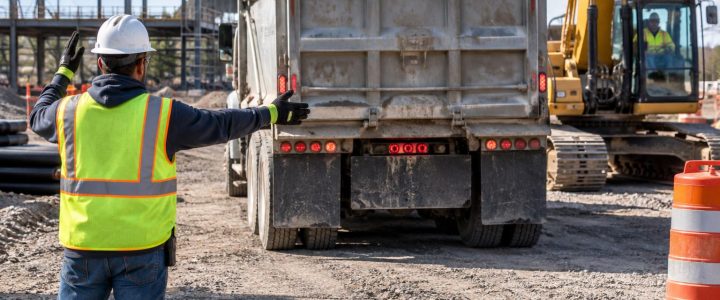
Raised dump beds are a frequent concern because the driver may be watching the material discharge rather than the space above the truck. Before dumping, verify overhead clearance at the entire unloading location, including the approach and any movement needed to pull forward. Keep the bed down until the truck is in the approved dump zone. Do not assume a route is safe just because another truck used it earlier.
Excavators, loaders, and telehandlers
Equipment height changes as the boom raises, the machine travels over uneven ground, or the load shifts. Operators should understand the machine’s maximum reach and height, but the supervisor should also account for the work envelope: boom movement, bucket position, fork elevation, load dimensions, and machine articulation.
Do not rely on a ground worker to “watch it” while also performing other tasks. If a spotter is used, establish where that person will stand so they are visible to the operator and remain outside equipment swing areas, travel paths, and other jobsite hazards.
Cranes, boom trucks, and lifting operations
Lifting near power lines requires deliberate planning. The hazard zone includes the boom, jib, load line, rigging, hook block, suspended load, and possible load swing. Wind can push a load toward a line, while ground settlement or a change in crane position can alter clearances.
Crane work near lines should be planned by personnel who understand the applicable OSHA requirements, lift conditions, and equipment limitations. If the work could bring any part of the equipment, load, or rigging close to the line, stop and determine the appropriate protective measures before proceeding.
Ladders, scaffolds, and long materials
Workers sometimes focus on machine hazards and overlook manual handling. Long metal ladders, sections of pipe, rebar, conduit, and scaffold frames can contact a line while being carried, lifted, or repositioned. Plan the carry path, control both ends of long material, and keep material handling away from overhead conductors.
What to do if equipment contacts an overhead line
An equipment-to-line contact is an emergency. The safest action depends on conditions, but the general priorities are to keep people away, prevent additional contact, and get the utility owner and emergency responders involved.
- Stay in the cab if it is safe to do so. The operator should avoid touching equipment and the ground at the same time.
- Warn everyone to stay away. Keep workers, bystanders, and other equipment away from the machine and the surrounding ground. Electricity may travel through the ground near the contact point.
- Do not allow anyone to touch the equipment. This includes workers attempting to help, drivers, spotters, or supervisors.
- Call emergency services and notify the utility owner. The line should be treated as energized until the utility owner confirms it has been de-energized.
- Exit only if remaining in the equipment presents an immediate danger. For example, fire may require escape. Training should address the correct emergency exit method: jump clear without touching the machine and ground at the same time, then move away with small shuffling steps while keeping both feet close together.
Do not attempt to move the machine away unless directed by the utility owner or emergency responders and it is necessary to protect life. A rushed attempt to separate equipment from a line can make the incident worse.
Before you start: overhead power line safety checklist
- Identify all visible overhead lines near work, access, staging, and unloading areas.
- Treat each line as energized unless the utility owner confirms otherwise.
- Determine the equipment and load envelope, not just the machine’s parked height.
- Confirm applicable minimum clearance requirements and create a larger practical buffer where possible.
- Relocate work zones, routes, and laydown areas away from lines whenever practical.
- Brief operators, ground crews, subcontractors, and delivery drivers.
- Assign a dedicated spotter or signal person when the plan calls for one.
- Mark restricted areas with barriers, signs, or other visible controls.
- Review the emergency response plan for a line contact.
- Reassess after weather changes, equipment changes, route changes, or a shift in work scope.
Common mistakes to avoid
- Assuming a visible line is safe because it is covered or appears insulated. Appearance does not establish electrical safety.
- Using only a verbal warning. A reminder is helpful, but routes, barriers, spotters, and clear work limits are more dependable.
- Measuring clearance only from the machine. Loads, rigging, dump beds, ladders, and extended booms may be closer.
- Letting a spotter perform other work. A spotter with divided attention is not an effective control.
- Failing to account for changing conditions. Rain, wind, darkness, uneven ground, and new deliveries can change the risk.
- Trying to help a worker or operator by approaching contacted equipment. Keep people back and call for help.
Make power-line awareness part of daily construction safety
Overhead power line safety works best when it is part of routine pre-task planning, not a last-minute discussion after equipment reaches the work area. Supervisors should ask where the equipment will travel, what will be raised, who may enter the work zone, and what conditions could reduce clearance.
For projects involving both overhead and underground utility risks, early site investigation and clear communication can help crews plan work zones with fewer surprises. Contact Visionary Subsurface Solutions to discuss your project and the practical information needed to support safer construction planning.