Backing heavy equipment, trucks, and delivery vehicles is a routine part of construction work, but it creates a serious struck-by hazard. Operators may have limited visibility behind or beside a machine. Workers on foot may assume they have been seen. A busy site can add noise, dust, uneven ground, changing work areas, and several employers working in the same space.
A good construction backing safety plan does not rely on one person watching more carefully. It controls the work area, limits unnecessary reversing, separates people from equipment, and gives operators and spotters a clear way to communicate. The goal is simple: no equipment moves into an area unless the operator knows it is clear.
Why backing creates a high-risk jobsite hazard
Every machine has blind areas. The size and location of those areas change with the type of equipment, attachments, load, cab design, mirrors, cameras, lighting, grade, and operator position. A dump truck backing toward a paver, an excavator swinging near a haul route, and a skid steer reversing from a stockpile all create different visibility challenges.
The most common problem is not necessarily an equipment failure. It is a breakdown in planning or communication. A worker enters a travel path to retrieve a tool. A driver backs up before a spotter is in position. A spotter moves out of view. A crew changes locations, but the delivery route was never updated. These events can happen quickly, especially when production pressure is high.
Audible alarms, cameras, mirrors, and proximity systems can help, but they do not eliminate blind spots or replace a controlled work zone. Workers may not hear an alarm over saws, generators, traffic, or hearing protection. Cameras can be obscured by mud, glare, or poor lighting. Technology should support a backing plan, not become the entire plan.
Start with the hierarchy of controls
The strongest controls reduce the need for workers and equipment to interact in the first place. Before relying on spotters, high-visibility clothing, or backup alarms, look for ways to redesign the operation.
Eliminate or reduce backing where possible
Ask whether the vehicle route can be changed so equipment can travel forward rather than reverse. This may include:
- Using one-way traffic patterns around the work area.
- Providing a designated turnaround area with adequate space and stable ground.
- Scheduling material deliveries when fewer workers are present.
- Locating stockpiles, dumpsters, and staging areas to reduce tight backing maneuvers.
- Planning dump locations that allow trucks to pull through or turn around safely.
- Using a different machine or material-handling method when a backing task cannot be controlled safely.
These changes often improve production as well as safety. A clear route reduces waiting, confusion, and repeated repositioning.
Create physical separation
Where people and equipment must work in the same general area, establish a physical boundary between them. Use barriers, fencing, cones, delineators, designated walkways, and controlled access points as appropriate for the site. Marking a pedestrian route is useful only if it stays outside equipment swing areas, backing paths, loading zones, and pinch points.
Keep workers out of truck loading and dumping areas unless their task requires entry and the operator has confirmed it is safe. Do not allow workers to walk between a truck and fixed object, pile, wall, or piece of equipment where a small movement can create a caught-between hazard.
Use administrative controls to manage movement
Traffic plans, pre-task discussions, trained spotters, delivery instructions, and equipment rules are important. They make the physical controls work in the field. They must be reviewed whenever site conditions change, not filed away after the initial site orientation.
Use PPE as the last line of defense
High-visibility garments can help an operator notice a worker in a clear line of sight. They do not make a person visible in a blind area, around a corner, or behind a loaded truck. PPE is necessary for many jobs, but it cannot compensate for poor route design or uncontrolled backing.
Before You Start: Backing safety questions for the crew
Before the first truck arrives or equipment begins moving, the superintendent, foreman, operator, and affected workers should be able to answer these questions:
- Where will equipment enter, travel, load, unload, turn, park, and exit?
- Which areas are off limits to pedestrians?
- Where are the blind spots and swing areas for each machine?
- Can this task be completed with less reversing or no reversing?
- Who is assigned as the spotter, and what other duties could distract that person?
- What hand signals, radio channel, or communication method will be used?
- Where will the spotter stand so the operator can see them and the hazard area?
- What is the stop-work signal?
- What changes are expected during the shift, such as deliveries, utility work, concrete placement, or crew turnover?
- Are the ground conditions stable enough for the planned route and maneuver?
If the crew cannot answer these questions, pause and resolve the plan before movement begins.
How to use a spotter safely
A spotter is most effective when the role is specific and uninterrupted. Assigning someone to spot while they also direct a concrete hose, carry materials, answer a phone, or manage a crew invites missed communication. For complex or congested movements, the spotter should have no competing task.
Position the spotter where they can be seen
The operator and spotter must establish eye contact or another confirmed communication method before the equipment moves. The spotter should stand where they can see the travel path, hazards, and the operator. They should remain outside the equipment’s path, outside the swing radius, and away from pinch points.
There is no single safe standing location for every machine. The correct position depends on the equipment, work area, and direction of travel. The practical rule is that the spotter must never stand behind equipment in its direct backing path or assume the operator can see them.
Use simple, agreed-upon signals
Review signals before the task. Keep them clear and limited. At a minimum, everyone should understand the signal for stop, proceed, turn, and emergency stop. If radios are used, test them before movement and use plain language. Avoid giving several commands at once.
A reliable operating rule is: if the operator loses sight of the spotter or does not understand the signal, the equipment stops. The operator should not continue based on an assumption that the path remains clear. The spotter should also call for a stop whenever people, vehicles, changing ground conditions, or other hazards enter the area.
Control everyone else around the movement
A spotter is not a substitute for keeping other workers out of the area. The spotter may be focused on one side of a truck while another worker approaches from the opposite side. Use a controlled zone and make sure the whole crew knows when backing is underway.
Operator practices that reduce backing risk
Operators have a central role in construction backing safety, but they need support from the site plan and the rest of the crew. Before moving, operators should inspect mirrors, cameras, windows, alarms, lights, tires or tracks, and the immediate travel path according to employer procedures and manufacturer instructions.
During the maneuver, operators should:
- Make a walk-around inspection when practical before entering a machine or moving a parked vehicle.
- Adjust mirrors and clean camera lenses and windows as needed.
- Travel slowly enough to stop for changing conditions.
- Keep loads as low and stable as the task and equipment instructions allow.
- Confirm the travel path is clear before moving and before changing direction.
- Stop when workers enter the controlled area, visibility is lost, or instructions are unclear.
- Avoid using a phone or other distraction while operating.
- Follow the manufacturer’s operating instructions and site-specific traffic rules.
Operators should never move equipment simply because a worker is waving. The operator needs to understand the intended instruction and be confident the movement can be made safely.
Supervisor responsibilities: make the plan workable
Supervisors set the conditions that determine whether workers can follow the plan. A rule that says “use a spotter” is not enough if no trained person is assigned, traffic routes overlap, or deliveries arrive without notice.
Effective supervision includes checking the site throughout the shift. Conditions can change after rain, during a pour, when a new subcontractor arrives, or as excavations, stockpiles, and temporary barriers move.
Build delivery controls into the project
Give delivery drivers clear instructions before they reach the active work area. Identify the entrance, check-in point, designated route, unloading area, speed expectations, and site contact. If a driver must reverse in a congested area, make sure a qualified site representative is ready to control the movement before the truck proceeds.
Do not expect a driver who is unfamiliar with the project to know which paths are clear, where workers are staged, or which route avoids underground work, trenches, stored materials, and overhead hazards.
Coordinate with excavation and underground work
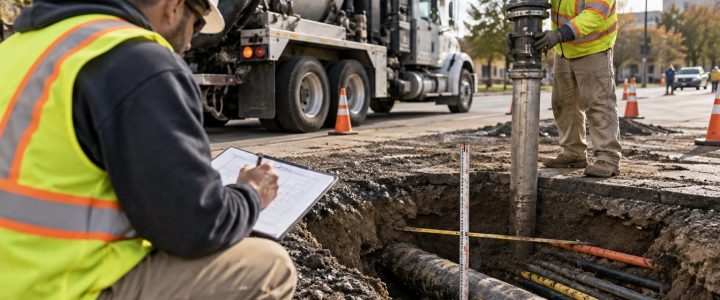
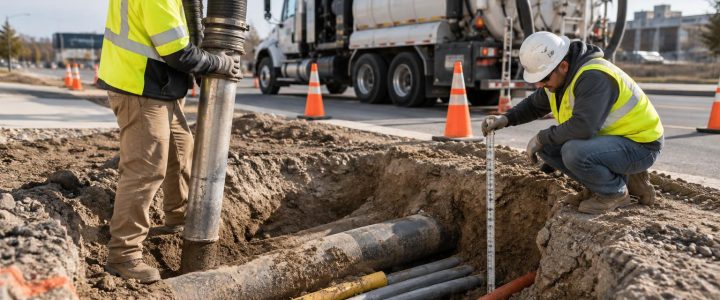
Traffic control deserves extra attention near trenches, test holes, vaults, manholes, and other openings. Heavy vehicles can damage protective systems, destabilize edges, or create hazards for workers below. Keep equipment and spoil piles back from excavations as required by the site conditions and applicable requirements, and have a competent person evaluate excavation conditions.
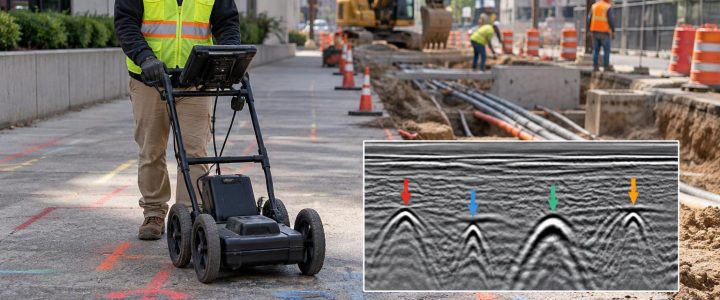
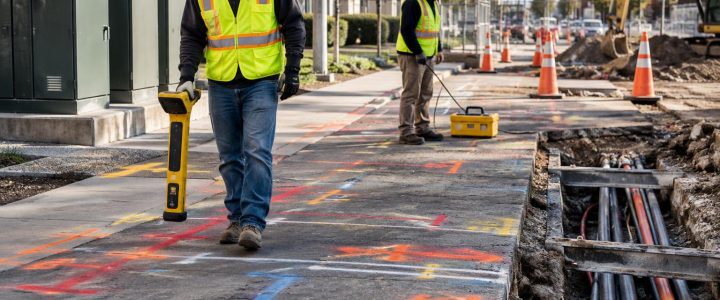
For work near known or suspected underground utilities, plan travel routes and staging areas carefully. Utility markings, exposed lines, and temporary utility support areas should remain visible and protected from unnecessary vehicle traffic. If the scope calls for verifying a utility’s position before excavation or construction, professional private utility locating and appropriate field verification can help the project team make better-informed decisions.
Common backing safety mistakes to avoid
- Using a spotter who is not dedicated to the task: Split attention creates gaps in communication.
- Assuming an alarm means the area is clear: An alarm warns others; it does not confirm that people have moved away.
- Letting workers shortcut through equipment routes: A few seconds saved on foot can place a worker in a blind area.
- Failing to update the traffic plan: Routes that worked during clearing may not work during utility installation, paving, or finishing.
- Backing toward a worker who is “just guiding”: The spotter must stay visible and outside the vehicle path.
- Ignoring poor visibility: Darkness, glare, dust, rain, fog, and dirty mirrors require a different plan or a pause.
- Allowing informal signals: A wave can mean many things. Agree on signals before the task.
What OSHA requires and what good practice adds
OSHA construction standards include requirements related to vehicles with an obstructed rear view. Under 29 CFR 1926.601, an employer generally must ensure that a vehicle with an obstructed view to the rear is not used in reverse unless it has a reverse signal alarm audible above surrounding noise levels or the vehicle is backed up only when an observer signals that it is safe to do so. The exact application depends on the equipment and work activity, so employers should review the standard and applicable site requirements rather than rely on a summary.
The regulation establishes an important baseline, but a strong jobsite plan usually goes further. Separating workers from mobile equipment, reducing backing movements, planning delivery routes, and stopping whenever communication is lost are practical controls supported by construction safety guidance from OSHA and the National Institute for Occupational Safety and Health.
For reference, review OSHA’s construction motor vehicle standard and NIOSH guidance on preventing worker injuries around vehicles and equipment. Employer policies, contract documents, local rules, equipment instructions, and site-specific conditions may require additional controls.
A field-ready construction backing safety checklist
- Routes, turnarounds, parking areas, and pedestrian paths are identified.
- Unnecessary backing has been eliminated where practical.
- Work zones are separated with physical controls where feasible.
- Equipment inspection is complete and visibility aids are clean and functioning.
- The operator knows the route and has checked the immediate area.
- A dedicated spotter is assigned when needed.
- The operator and spotter have reviewed signals and confirmed the stop signal.
- The spotter has a safe position with continuous visibility to the operator.
- Other workers know to remain outside the controlled backing area.
- Delivery drivers have clear instructions and a site contact.
- The plan has been adjusted for weather, lighting, ground conditions, and changing site activity.
Make stopping an expected part of the work
Equipment movement should stop whenever conditions are unclear. That is not a delay caused by safety; it is a normal control for a changing construction environment. Workers should be expected to speak up when they enter an equipment area, lose contact with an operator, see a pedestrian in a blind spot, or notice that the route no longer matches the plan.
Construction backing safety works best when the crew treats traffic control as part of the operation, not as an afterthought. Base each decision on current site conditions, applicable requirements, worker training, equipment manufacturer instructions, and sound professional judgment.
If your project involves excavation, congested access, or uncertain subsurface conditions that affect equipment routes and work planning, contact Visionary Subsurface Solutions to discuss the project and available field-support options.