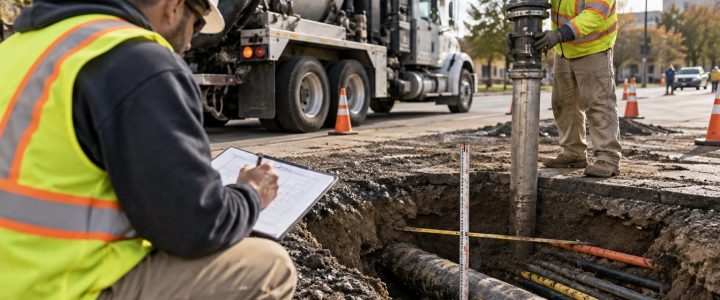
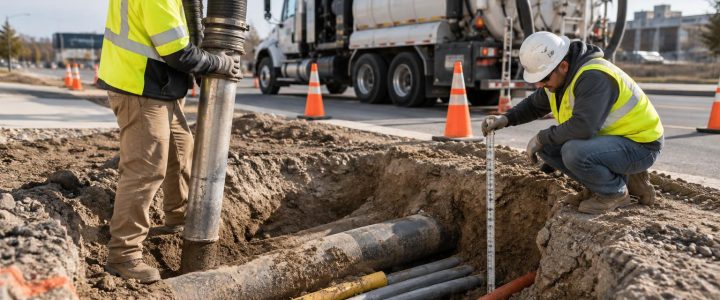
Buying, redeveloping, or expanding a commercial property can reveal costly unknowns below grade. Aging sanitary sewers, buried storm drains, abandoned laterals, damaged connections, and undocumented drainage routes can all affect design, schedule, and maintenance planning. A professional commercial sewer and storm drain inspection gives the project team visual information about accessible piping before major decisions are made.
Video pipe inspection is especially useful when drawings are incomplete, drainage complaints exist, or a planned improvement may connect to, cross, or rely on an existing private pipe system. It does not replace surveying, utility locating, cleaning, testing, or engineering analysis. It does, however, provide direct visual evidence of what can be seen inside an accessible pipe.
For property owners, developers, contractors, and engineers, that evidence can help define follow-up work before a hidden pipe issue becomes a construction change, a drainage failure, or a recurring sewer backup.
Why inspect underground pipes before redevelopment?
Existing stormwater and sanitary systems often become part of the redevelopment plan. A site may need to maintain service to occupied buildings, connect new improvements to an existing manhole, reuse an outlet structure, or manage runoff through older on-site piping. Before relying on those assets, the team should understand their observable condition and configuration.
A CCTV sewer inspection or stormwater pipe inspection can help answer practical questions such as:
- Is there a passable pipe between the available access points?
- What visible pipe materials, joints, changes in diameter, and connections are present?
- Are there roots, sediment, grease, debris, standing water, or other obstructions?
- Are visible cracks, holes, displaced joints, open joints, deformation, or collapse present?
- Does the camera identify laterals, branch connections, inlets, manholes, or other recognizable features?
- Does the observed route appear consistent with available record drawings and surface structures?
- Should the project budget for cleaning, repair, further investigation, rehabilitation, or replacement?
These answers are important, but they must be used carefully. A camera can document visible conditions within the portion of pipe it can reach. It cannot, by itself, prove that a pipe has adequate structural capacity, establish ownership, or provide a surveyed horizontal and vertical alignment.
What a video pipe inspection can show
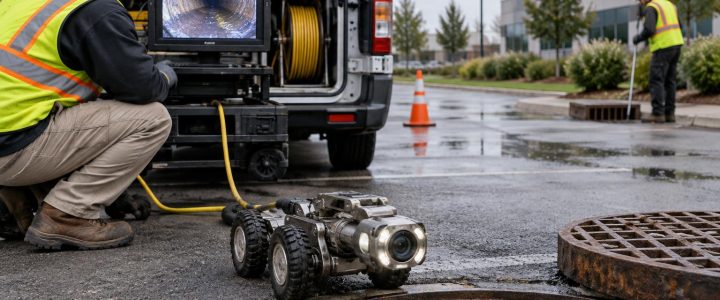
Professional video pipe inspection generally uses a push camera or robotic crawler with a camera, lighting, and recording equipment. The selected equipment depends on pipe diameter, access conditions, flow, bends, and the purpose of the inspection. The operator advances the camera from an accessible point, observes the interior, and records notable features and limitations.
Visible condition findings
A useful inspection may document observable defects or maintenance concerns, including:
- Cracks, fractures, breaks, holes, and missing wall sections
- Open, offset, separated, or displaced joints
- Root intrusion at joints or service connections
- Sediment, trash, construction debris, grease, or mineral deposits
- Deformation, sagging indicators, or sections that appear damaged
- Evidence of infiltration where water appears to enter the pipe
- Visible connections, laterals, tie-ins, and changes in pipe material or size
- Obstructions that prevent the camera from progressing farther
Video observations can identify where more attention is needed. They do not always determine why a defect occurred or whether it is structurally significant. For example, a visible crack may result from installation damage, loading, settlement, aging, or another condition that cannot be confirmed from the camera view alone. A licensed engineer or other qualified project professional may need to evaluate repair options and structural implications.
Route and connection clues
When a camera travels through a pipe, it can help establish the apparent route between known access points and identify visible connections along that route. This is valuable when investigating a suspected lateral, an undocumented branch, or a drainage pipe that does not match the available plans.
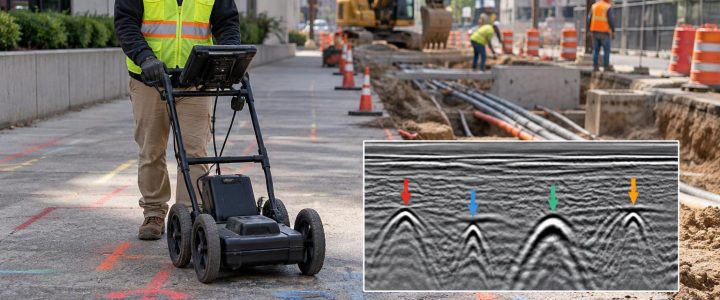
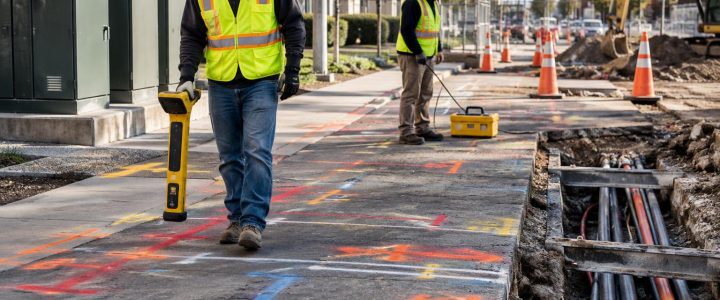
However, inspection is not the same as pipe locating. Video alone does not automatically produce a precise map. In some situations, a sonde transmitted from the camera can be traced at the surface to estimate the camera location. That work may be affected by depth, soil conditions, congestion, signal interference, access, and pipe configuration. Where design or excavation decisions depend on pipe coordinates and elevations, the project may need dedicated private utility locating, survey control, manhole measurements, test holes, or other investigation.
When a pre-development inspection is most valuable
Not every property needs the same level of pipe investigation. A focused inspection is often appropriate when an existing pipe system may affect the feasibility, cost, or sequencing of planned work.
Before acquiring a commercial or industrial property
For a prospective buyer, accessible storm and sanitary lines can be part of practical due diligence. The goal is not to make a broad guarantee about the entire underground system. The goal is to document accessible segments, recognize visible concerns, and identify items that deserve further review before relying on the system.
Inspection may be particularly useful when there are signs of ponding, repeated backups, aging structures, unknown discharge paths, prior drainage repairs, or limited infrastructure records.
During civil design for a redevelopment site
An engineer may need to determine whether existing pipes can remain in service, whether connections are where plans indicate, or whether a suspected pipe route conflicts with new utilities, foundations, pavement, or stormwater facilities. A video sewer inspection can provide details that are not visible from a manhole rim or inlet grate.
When those observations must become design-ready utility information, CCTV data can be paired with survey and subsurface utility engineering. Visionary Subsurface Solutions can coordinate pipe findings with Subsurface Utility Engineering & QL-B work when the project requires a broader investigation of underground features.
Before connecting new work to an existing system
A proposed tie-in can depend on an existing pipe being open, properly connected, and in acceptable visible condition. Inspecting upstream and downstream, where access allows, can reveal debris, offset joints, unknown branches, or obstructions that may complicate the connection.
After a drainage or sewer complaint
Repeated pavement ponding, slow drainage, odor complaints, sanitary backups, or unexplained wet areas can all justify a targeted drain pipe inspection. The video may identify a blockage, sediment accumulation, root intrusion, a damaged section, or a configuration issue. If the cause cannot be confirmed visually, the inspection still helps narrow the next investigation step.
Plan the inspection before the crew arrives
Field conditions strongly affect whether an inspection produces meaningful footage. A short planning discussion can prevent an avoidable mobilization or a video that stops before the area of concern.
- Gather available information. Provide record drawings, utility maps, prior inspection reports, drainage complaints, known access structures, and the limits of the project area.
- Identify access points. Manholes, cleanouts, inlets, catch basins, roof-drain connections, and other structures may provide entry. Safe access and traffic control requirements should be considered in advance.
- State the inspection purpose. The scope may be to investigate a blockage, trace apparent connections, document pre-existing conditions, review new installation quality, or support rehabilitation planning.
- Consider cleaning first. Heavy sediment, grease, roots, debris, and high water can obscure the pipe wall or block camera travel. Cleaning may be necessary before a condition-focused inspection can be completed.
- Define the needed deliverables. Confirm whether the project needs video files, observation logs, defect coding, pipe segment references, still images, location support, or a discussion of recommended follow-up investigation.
Understanding PACP and standardized pipe condition data
For larger sanitary sewer and storm sewer programs, owners and engineers may request inspections that use standardized condition-assessment terminology. The National Association of Sewer Service Companies developed the Pipeline Assessment Certification Program, commonly called PACP, to standardize how pipeline observations are coded and reported. Its companion programs include LACP for laterals and MACP for manholes.
A PACP-style assessment can make it easier to compare observations across pipe segments, contractors, and inspection cycles. Standard coding supports a more consistent record of observed defects, locations, and severity categories. It can be useful for asset management, maintenance planning, and rehabilitation prioritization.
It is important to confirm the requested method at the start. Not every camera inspection is a PACP, LACP, or MACP assessment, and a video file alone is not automatically a standardized condition report. The U.S. Environmental Protection Agency’s collection-system management materials and NASSCO’s PACP program both emphasize the value of documented inspection information for understanding and managing collection-system conditions. See the EPA CMOM resources and NASSCO PACP information for program-level context.
What to expect in a professional inspection report
The report format should match the project objective, but useful pipe inspection services commonly provide a clear link between field observations and the footage. Depending on the scope, deliverables may include:
- Identification of the inspected segment and available access points
- Inspection direction and approximate distance traveled, when measured by the equipment
- Video files and selected still images
- Observed pipe material, diameter, and visible features where discernible
- Recorded observations such as roots, debris, offsets, cracks, connections, or obstructions
- Locations where the inspection stopped or visibility was limited
- Notes identifying recommended next steps, such as cleaning, locating, survey, test holes, or engineering review
Distance shown on a camera counter is useful field information, but it should not be treated as a surveyed position without appropriate control and verification. Likewise, a camera observation may show water entering a joint, but additional assessment may be needed to determine the source, extent, and repair approach.
Common limitations to keep in mind
Video inspection is powerful because it provides a direct interior view. Its limits should be stated as clearly as its findings. A camera may be unable to inspect a pipe that is inaccessible, fully collapsed, severely blocked, submerged, heavily sedimented, or too small or sharply configured for the selected equipment. Bends, offsets, active flows, protruding connections, poor access, and unsafe site conditions can also limit progress.
In those cases, the right response may be cleaning, a different access point, a different camera setup, surface locating, controlled excavation, flow assessment, or engineering evaluation. A professional inspection should document the limitation rather than imply that unseen pipe has been evaluated.
Use the findings to make a better next decision
A commercial sewer and storm drain inspection is most useful when it is part of a practical investigation plan. The inspection may confirm that an accessible segment appears clear enough for the intended use. It may also identify an issue early enough to adjust design, plan cleaning, investigate a suspected connection, or budget for rehabilitation before construction is underway.
For redevelopment, acquisition, drainage troubleshooting, or infrastructure planning in Pennsylvania, New Jersey, Delaware, Maryland, New York, or the Washington, D.C. to New York City corridor, contact Visionary Subsurface Solutions to discuss professional video pipe inspection and the related investigation services that may fit your project.
Frequently asked questions
Can CCTV inspection locate an underground sewer or storm drain?
It can help establish the apparent route of an accessible pipe and identify connections or recognizable structures. With appropriate equipment, a camera sonde may sometimes be traced from the surface. Precise mapping normally requires additional locating and survey methods, and conditions may limit what can be traced.
Can a camera inspection prove that a pipe is structurally sound?
No. Video can document visible defects and conditions, but it does not by itself establish structural capacity or the cause of every defect. Engineering review or additional testing may be appropriate when structural decisions are required.
Should a newly installed pipe be inspected before acceptance?
Many project teams use post-installation video inspection to document accessible pipe interiors, check for construction debris, observe connections, and identify visible concerns before final acceptance. The specific acceptance requirements should follow the project specifications and owner requirements.
Do storm pipes need cleaning before camera inspection?
Sometimes. Sediment, debris, roots, grease, and standing water can prevent meaningful viewing or stop the camera. The inspection provider can help determine whether cleaning should be scheduled before the camera work.