Existing storm sewer systems can create major uncertainty before a site is graded, a roadway is rebuilt, or a new utility connection is made. Plans may show old pipe routes, but the records may not reflect field changes, abandoned segments, damaged structures, or unknown connections. A storm sewer that appears serviceable on a drawing may be partially blocked, damaged, or routed differently than expected.
A professional storm sewer inspection before construction gives the project team visual information about accessible pipe interiors before work changes the site. CCTV and robotic pipe inspection can document observable conditions, trace pipe travel from an available access point, identify connections and structures, and help the team decide where further investigation is needed.
This is not the same as a complete utility locate or an engineering evaluation. Video inspection is one part of a coordinated preconstruction investigation. When used at the right time, it can help contractors, engineers, owners, and municipalities make better decisions about tie-ins, drainage improvements, protection measures, and existing-condition documentation.
Why inspect existing storm sewers before construction?
Construction near an active drainage system often depends on assumptions: that a pipe is open, that it connects where the plans indicate, that it can accept a new tie-in, or that it will tolerate nearby excavation and loading. An underground pipe inspection helps test those assumptions without immediately exposing the full system.
Common reasons to order a preconstruction storm drain inspection include:
- Planning a connection to an existing storm sewer or inlet.
- Investigating an unknown drainage route before site design is finalized.
- Documenting pipe condition before adjacent excavation, paving, demolition, or utility installation.
- Assessing a culvert, drainage run, or storm lateral before rehabilitation or replacement planning.
- Investigating ponding, slow drainage, sinkholes, or repeated inlet backups.
- Reviewing existing infrastructure before buying, developing, or redeveloping a property.
- Confirming whether accessible pipes appear to be connected, obstructed, damaged, or abandoned.
- Creating baseline records when construction could later affect a municipal or private drainage system.
For a civil engineer, this information can support design decisions. For a contractor, it can identify conditions that deserve clarification before crews mobilize around a critical drainage line. For an owner or facility manager, it provides a dated record of observable conditions before a project begins.
What a CCTV storm sewer inspection can show
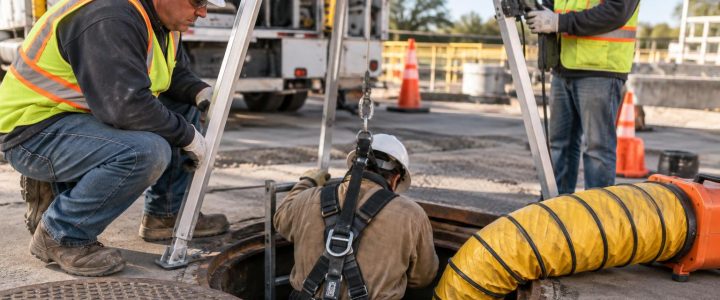
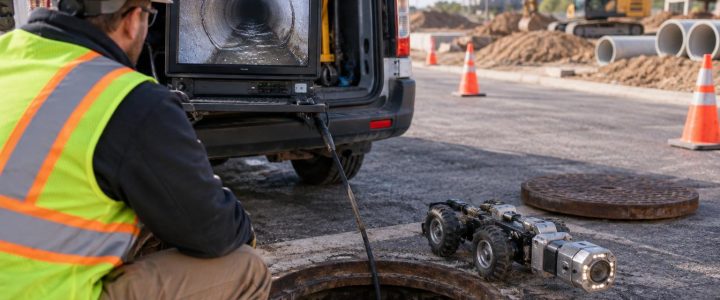
Video pipe inspection uses a camera system introduced through a manhole, inlet, cleanout, catch basin, pipe end, or other suitable access point. A push camera may be used in smaller accessible lines, while a remotely operated crawler is often used for larger pipes and longer runs where site conditions allow.
As the camera travels through the pipe, the inspection team records video and notes relevant features. Depending on access, pipe size, flow, cleanliness, bends, and obstructions, an inspection may help identify:
- Visible cracks, fractures, breaks, holes, or separated sections.
- Open, offset, displaced, or otherwise defective-looking joints.
- Deformation, flattening, sagging, or areas that appear damaged.
- Root intrusion, sediment, debris, construction material, or other blockage.
- Standing water, deposits, grease, or material reducing the apparent flow area.
- Visible connections, laterals, inlets, manholes, and changes in pipe direction.
- Changes in pipe type, diameter, lining, or interior condition where visible.
- Evidence that a pipe run is inaccessible beyond a blockage, collapse, submerged area, or tight configuration.
These observations are useful, but they need careful interpretation. A camera can show that a joint appears open or that water is entering at a location. It does not, by itself, establish why the condition exists, whether it is structurally significant, or what repair method is appropriate. Those questions may require engineering review, cleaning, flow investigation, survey data, soil information, testing, or targeted excavation.
Pipe inspection, pipe locating, and condition assessment are different tasks
Project teams sometimes use these terms interchangeably, but they answer different questions.
Video pipe inspection
Video inspection looks inside an accessible pipe. It is primarily used to observe condition, connections, obstructions, and other interior features. It can also provide clues about the pipe route as the camera passes known structures or identifiable features.
Pipe locating
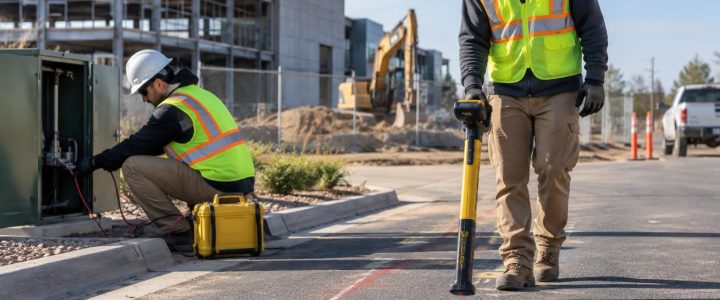
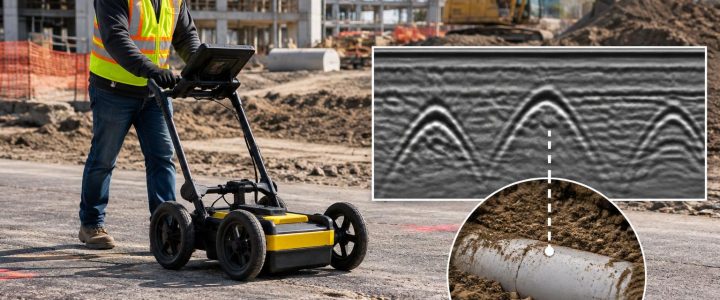
Pipe locating is the effort to establish the horizontal position of a pipe or related feature on the ground. A camera sonde, transmitter, or other locating method may help trace an accessible nonmetallic pipe in some conditions. However, CCTV inspection alone does not always produce a precise, surveyed horizontal or vertical location. Signal quality, depth, congestion, access, pipe material, and field conditions can all affect results.
When a project needs a defensible route, depth, and elevation for design or excavation planning, the team may need private utility locating, survey control, or physical verification. Visionary Subsurface Solutions can coordinate inspection findings with private utility locating when the project calls for more than a visual interior review.
Condition assessment
A condition assessment organizes inspection observations so an owner or engineer can prioritize maintenance, rehabilitation, or further investigation. Some municipal and utility programs require standardized coding and reporting. Where required by the project, NASSCO PACP and LACP concepts can provide a common method for documenting pipe and lateral observations. Not every camera inspection is a PACP or LACP assessment, so the requested reporting standard should be discussed before fieldwork begins.
A practical preconstruction inspection workflow
The best results usually come from planning the inspection around the project decision it needs to support. Sending a camera into a pipe without defining the purpose can produce video but not necessarily useful project information.
- Define the decision. Identify what the team needs to know. Is the goal to plan a tie-in, investigate a blocked inlet, document existing conditions, review a suspected damaged segment, or support rehabilitation design?
- Gather available records. Provide utility plans, drainage plans, as-builts, prior inspection records, survey files, and site photos when available. These records guide the work but should not be treated as proof of current field conditions.
- Identify access points and safety constraints. Note manholes, inlets, cleanouts, outfalls, pipe ends, traffic conditions, work-zone limits, water levels, and any site access restrictions.
- Prepare the pipe if needed. Heavy sediment, roots, debris, grease, or standing water can limit visibility and prevent camera travel. Cleaning may be needed before a meaningful inspection can be completed.
- Perform the inspection and record observations. The field team documents accessible segments, direction of travel, structures, visible defects, and points where progress stops or conditions change.
- Review findings against the project plan. Compare video observations with available plans and proposed work limits. Flag discrepancies, uncertain routes, damaged areas, and locations needing additional verification.
- Use follow-up methods selectively. Consider locating, survey, test holes, cleaning, flow testing, or engineering review only where the inspection identifies a decision-critical uncertainty.
What to look for before a tie-in or nearby excavation
Existing storm sewer pipe is often most important where the project will connect to it, cross it, place fill above it, excavate near it, or rely on it to carry runoff during construction. In these areas, the inspection scope should focus on practical risks.
Connection and continuity questions
- Does the accessible pipe appear to continue in the expected direction?
- Are there visible branches, laterals, inlets, or junctions that should be accounted for?
- Does the proposed tie-in area appear obstructed, damaged, or heavily sedimented?
- Do observed features generally align with available drawings, or are there material differences to resolve?
Condition questions
- Are there visible defects near the proposed work area?
- Is the pipe already showing signs of deformation, joint movement, cracking, or material loss?
- Is there sediment or debris that reduces the usable interior area?
- Are roots or other intrusions likely to interfere with cleaning, connection work, or drainage performance?
Constructability questions
- Is the pipe accessible from a manhole, inlet, cleanout, or outlet?
- Can the camera travel far enough to observe the relevant section?
- Will cleaning, bypass planning, traffic control, or additional access be needed?
- Should a suspected crossing or elevation be confirmed by survey or vacuum excavation before excavation starts?
Limits that should be understood before scheduling
A camera inspection is valuable only where the pipe can be accessed and viewed with reasonable clarity. A severely collapsed pipe, fully blocked line, submerged segment, tight bend, damaged access structure, or pipe with excessive debris may limit camera progress. A report should clearly distinguish between pipe that was observed and pipe that could not be inspected.
Likewise, visual evidence of infiltration, a cracked wall, or an open joint is an observation, not a complete diagnosis. The source of water entry, extent of exterior voiding, pipe load capacity, and long-term structural significance cannot always be determined from internal video. A qualified engineer should evaluate repair or replacement decisions when structural performance is in question.
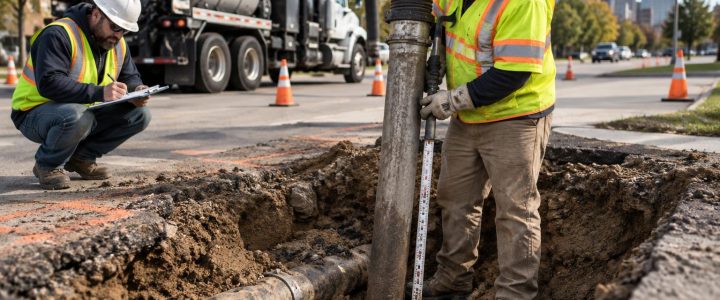
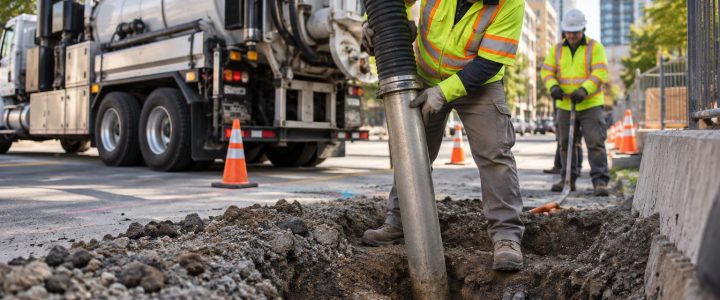
Where a critical location, crossing, or depth must be verified before excavation, non-destructive exposure may be appropriate. Vacuum excavation and QL-A test holes can provide direct confirmation at targeted points while limiting the disturbance of conventional digging.
What to request in a professional storm sewer inspection deliverable
For a construction or engineering project, a useful deliverable should be more than a video file. Before work begins, agree on the information the report needs to support.
- Project name, inspection date, and inspected system or area.
- Access point and direction of inspection for each pipe segment.
- Pipe segment identifiers tied to available plans or field labels where possible.
- Video files or reviewable footage with clear segment references.
- Still images of notable observations when useful.
- Observed connections, structures, obstructions, and apparent defects.
- Distance references when equipment and conditions permit reliable collection.
- A clear note of areas that could not be reached or visually assessed.
- Standardized coding when it is required by the owner or project specifications.
These records can support construction planning, owner coordination, design review, and future maintenance decisions. They can also establish a better baseline if concerns arise after nearby work is completed.
FAQ: storm sewer inspection before construction
Can CCTV inspection locate a storm sewer?
It can help trace an accessible pipe route and identify known structures, connections, or changes along the run. It should not be assumed to provide a precise surveyed location or depth by itself. Use locating, survey, or direct verification when the exact position or elevation matters to design and excavation.
Should storm sewer pipe be cleaned before camera inspection?
Often, yes. Cleaning may be appropriate when sediment, debris, roots, grease, or standing water prevents the camera from traveling or obscures the pipe wall. The need for preparation depends on the pipe condition and the purpose of the inspection.
Can video inspection prove that a storm sewer is structurally sound?
No. Video can document visible interior conditions and potential defects, but it does not independently establish structural capacity or the cause of every observed defect. Engineering analysis or additional investigation may be needed.
When should the inspection occur?
Schedule it early enough to use the findings in design coordination, tie-in planning, bid preparation, or sequencing decisions. If the purpose is to document conditions before construction activity, complete the inspection before work begins near the relevant system.
Plan around the pipe system you actually have
Preconstruction storm sewer inspection helps replace assumptions with field observations. It can reveal accessible pipe conditions, identify apparent connections and obstructions, document limitations, and direct the team toward the next appropriate step. That may be cleaning, locating, surveying, engineering review, or targeted verification—not necessarily immediate repair.
Visionary Subsurface Solutions provides professional video pipe inspection for stormwater, sanitary sewer, drainage, and other accessible pipe systems throughout Pennsylvania, New Jersey, Delaware, Maryland, New York, and the Washington, D.C. to New York City corridor. Contact our team to discuss the access, documentation, and investigation needs for your upcoming project.