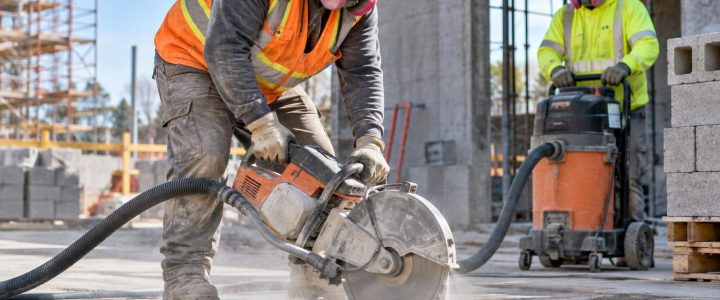
Concrete coring, saw cutting, anchor drilling, and selective demolition can create serious problems when embedded features are unknown. A missed reinforcing bar may damage a structural element. Striking post-tensioning tendons, conduits, piping, or electrical components can create a much larger safety, schedule, and repair issue.
GPR concrete scanning before coring, cutting, or drilling helps project teams investigate the slab or wall area before making a penetration. Ground penetrating radar can identify contrasts within concrete that may indicate reinforcing steel, conduits, void-like conditions, changes in thickness, or other embedded features. It is a valuable planning tool, but it is not a guarantee that every item will be detected or identified.
For critical work, the practical goal is not simply to “scan the concrete.” The goal is to use GPR findings, project information, visible conditions, and field verification to choose a safer work location and reduce uncertainty before destructive work begins.
Why concrete scanning matters before penetrations
Concrete often contains much more than a crew can see from the surface. Depending on the structure, embedded conditions may include reinforcing steel, welded wire reinforcement, post-tension cables, electrical conduits, communication pathways, hydronic lines, drain piping, sleeves, inserts, and prior repairs. Renovation work can add another layer of uncertainty when drawings are incomplete, outdated, or unavailable.
A scan can help a contractor or engineer make better decisions before:
- Coring a floor slab for new plumbing, ductwork, or conduit
- Saw cutting openings for trench drains, elevators, or structural modifications
- Drilling holes for anchors, dowels, handrails, equipment, or façade attachments
- Installing signs, racking, guards, or mechanical supports
- Investigating suspected slab thickness changes or prior patch areas
- Planning selective demolition around structural elements
GPR results are particularly useful when a planned opening is near columns, beams, joints, utility risers, electrical rooms, mechanical spaces, or other areas where embedded congestion may be more likely.
How GPR concrete scanning works
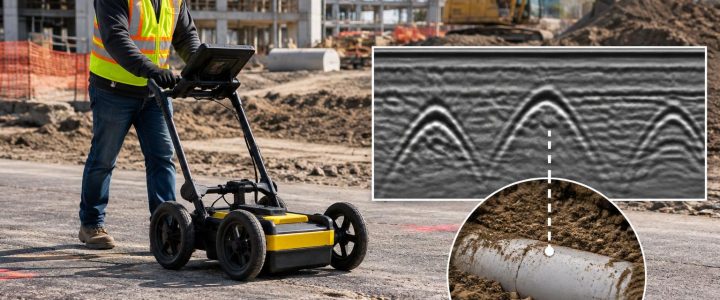
Ground penetrating radar sends short electromagnetic pulses into the concrete and records reflections returning to the antenna. Reflections occur where the signal encounters a change in electromagnetic properties. Steel reinforcement, air-filled spaces, embedded conduits, interfaces between materials, and changes in moisture can all produce responses.
The scanner is moved across the surface in planned lines or a grid. The resulting data is reviewed for recurring patterns, linear responses, localized anomalies, and changes at different scan directions. A technician interprets these responses in the context of the structure and the planned work.
GPR does not take a literal photograph through concrete. It produces data that must be interpreted. A strong response may be consistent with reinforcing steel, but interpretation depends on pattern, orientation, depth estimate, signal behavior, and site conditions. A response that looks like a conduit in one area may be affected by reinforcement, moisture, or surface conditions in another.
Federal Highway Administration guidance and technical resources from the Federal Highway Administration and the National Institute of Standards and Technology describe GPR as a nondestructive method that relies on interpretation of reflected electromagnetic signals. The method is useful, but conditions within the material affect what can be resolved.
What GPR may help identify in concrete
A properly planned scan may provide information that helps the project team avoid or further investigate embedded conditions. Depending on the slab, wall, access, and data quality, findings may include:
- Likely reinforcing bar direction and approximate spacing
- Areas with multiple reinforcement layers or dense reinforcement
- Responses consistent with metallic or non-metallic conduits
- Potential sleeves, openings, inserts, or embedded objects
- Approximate location of recurring linear features
- Localized anomalies that deserve additional review before penetration
- Relative changes that may indicate a change in slab construction or thickness
These findings are best used to mark potential concern areas, adjust a proposed penetration, or determine where additional investigation is needed. They should not be treated as confirmation of a utility’s service, ownership, contents, condition, or exact position.
What GPR cannot reliably tell a project team
One of the most important parts of GPR concrete scanning is understanding its limits. A scan cannot reliably answer every question needed for construction.
It does not identify every target with certainty
GPR detects contrasts, not labels. An embedded response may be interpreted as likely steel, a likely conduit, or an anomaly requiring caution. Confirming the exact material or function may require drawings, additional testing, limited exposure, or another inspection method.
It does not guarantee a clear drilling location
A marked area can reduce risk, but it does not prove that no feature is present. Small targets, deeply embedded targets, closely spaced reinforcement, and weak contrasts may not be distinguishable in the data. A competent scan should inform the work plan, not replace project-specific safety procedures or engineering review.
Depth estimates are not absolute measurements
Depth estimates depend on the radar signal velocity used during interpretation. Concrete composition, moisture, aggregate, and other conditions can affect that velocity. Depth should be treated as an estimate unless it is verified by a suitable method.
It does not establish structural approval
Finding reinforcement is not the same as determining whether it may be cut or drilled. Decisions that could affect structural capacity, post-tensioned elements, fire rating, waterproofing, or building systems should be reviewed by the appropriate design professional and facility representative.
Post-tensioned concrete requires added caution
Post-tensioned slabs deserve special attention. Tendons can be under high stress, and damaging one can create a dangerous condition as well as substantial repair work. GPR may help identify recurring embedded features, but it should not be used as the sole basis for approving a cut, core, or deep anchor in a suspected post-tensioned area.
Before work proceeds, the project team should seek available structural records, identify the slab type where possible, involve the responsible engineer when needed, and establish a clear approval process. If there is uncertainty about tendons or other critical components, changing the location or method of work may be the safer decision.
What affects GPR concrete scanning results
Every concrete structure presents different conditions. The quality and usefulness of a GPR survey can be influenced by:
- Reinforcement density: Closely spaced steel can mask or complicate responses from deeper features.
- Multiple reinforcement mats: Upper layers may make it harder to interpret lower layers.
- Concrete thickness: Thicker sections may limit the ability to resolve deeper features.
- Moisture and material variation: Water content, aggregate type, and concrete condition can change signal behavior.
- Target size and orientation: A long target that runs parallel to the scan direction may be interpreted differently than a perpendicular target.
- Surface accessibility: Coatings, roughness, obstructions, walls, equipment, and limited work space can restrict scan coverage.
- Surface condition: Debris, standing water, loose materials, and uneven surfaces can reduce antenna contact or make systematic scanning difficult.
These limitations do not make GPR unhelpful. They explain why an experienced interpretation and realistic expectations are essential.
A practical workflow for GPR scanning before coring or cutting
A productive survey starts before the technician arrives. The following process helps align the scan with the actual construction decision.
- Define the proposed work area. Mark or describe the intended core, cut line, anchor layout, or opening dimensions. A broad request to “scan the slab” is less useful than identifying the decision that needs to be made.
- Gather available information. Existing structural drawings, MEP drawings, renovation records, and known utility routes can guide the investigation. They are useful references, but field conditions may differ from records.
- Make the surface accessible. Remove loose materials where practical and provide safe access to the area. Clearly identify any active operations, hazards, or restricted zones.
- Scan in more than one direction when practical. Orthogonal scan lines often improve the ability to recognize the direction and pattern of embedded features.
- Review and mark findings. Marked responses should be tied to the planned work area, with notes about uncertainty or limitations where appropriate.
- Adjust the plan or verify critical findings. Move the penetration, revise the layout, consult the engineer, or use limited verification when the consequence of an error is high.
GPR scanning and underground utility detection: similar tool, different environment
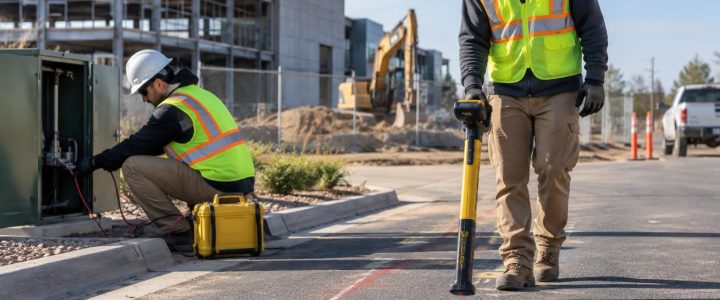
The same core GPR principle is used in subsurface investigation outside a structure. For ground penetrating radar utility locating, antennas are moved across soil, pavement, sidewalks, or other accessible surfaces to look for reflections associated with buried utilities and unknown features.
Below ground, GPR can sometimes provide useful information about non-metallic utilities, including PVC, HDPE, concrete, and other pipes that may not be directly traceable with electromagnetic equipment. It can also help investigate possible abandoned lines, tanks, foundations, void-like anomalies, and congested corridors. However, soil moisture, clay-rich soils, depth, utility size, surrounding material, and congestion can substantially limit results.
GPR and electromagnetic locating are often complementary. Electromagnetic methods can be highly effective for tracing conductive utilities or tracer wires. GPR can add information about non-conductive lines and other subsurface changes when conditions support it. Neither method alone should be assumed to find every utility, and critical conflicts may still require physical verification.
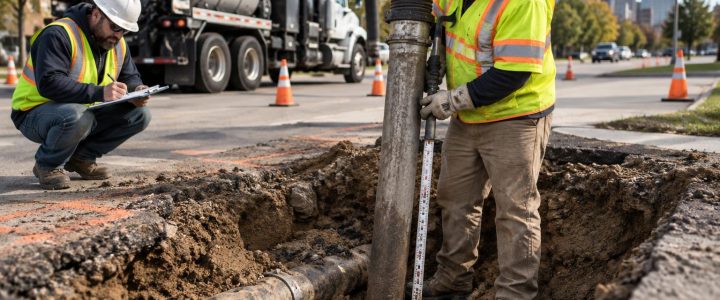
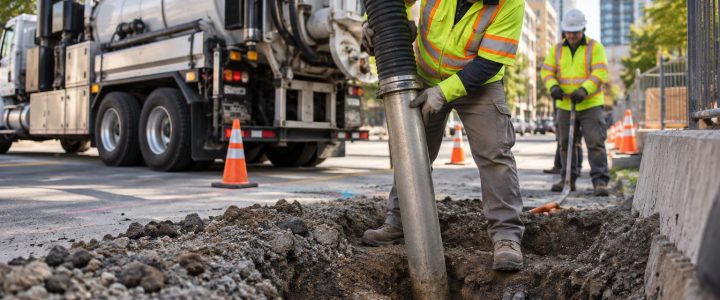
For projects involving exterior excavation or unknown private utilities, GPR may be combined with private utility locating and, when needed, vacuum excavation and QL-A verification. Physical exposure is the appropriate next step when the actual horizontal or vertical position of a utility must be confirmed.
When to bring in professional GPR services
Professional GPR survey services are especially worthwhile when the work is difficult to reverse or the cost of a strike is high. Examples include large-diameter coring, deep anchors, post-tensioned structures, hospital and data-center work, occupied facilities, industrial plants, utility-rich renovation areas, and design investigations with incomplete records.
A qualified provider can select an appropriate scanning approach, recognize when conditions limit confidence, communicate findings in relation to the proposed work, and recommend when verification or another method should follow. That practical judgment is as important as the equipment itself.
Frequently asked questions about GPR concrete scanning
Can GPR find conduits in concrete?
GPR may identify responses consistent with conduits, especially where there is enough contrast between the conduit and surrounding concrete. Results can be complicated by dense reinforcement, depth, conduit size, material, moisture, and congestion. A response should not be assumed to identify the conduit’s service or exact path without supporting information.
Can GPR tell how deep rebar is?
It can provide an estimated depth based on the interpreted signal and assumed material properties. That estimate is useful for planning, but it is not a substitute for direct measurement or verification when depth is critical.
Should a slab be scanned before every anchor is drilled?
The answer depends on the anchor depth, structural system, building use, consequences of damage, and available records. Deep anchors, critical installations, uncertain slab conditions, and suspected post-tensioning generally justify more careful investigation.
Is GPR enough before excavation outside a building?
Not always. GPR can be a useful part of underground utility detection, but site conditions may limit it. Combining GPR with electromagnetic locating, records research, visual evidence, and targeted vacuum excavation provides a more defensible investigation when utility conflicts are important.
Plan the scan around the construction decision
The value of GPR concrete scanning is not in producing marks alone. It is in helping the project team decide where to core, cut, drill, redesign, or verify before a hidden condition becomes a field problem. Clear work limits, accessible surfaces, available records, and a realistic understanding of GPR limitations all lead to better results.
Visionary Subsurface Solutions provides GPR services for concrete scanning, underground utility detection, and construction-focused subsurface investigations across Pennsylvania, New Jersey, Delaware, Maryland, New York, and the Washington, D.C. to New York City corridor. Contact our team to discuss the planned work, site conditions, and the level of verification your project may need.