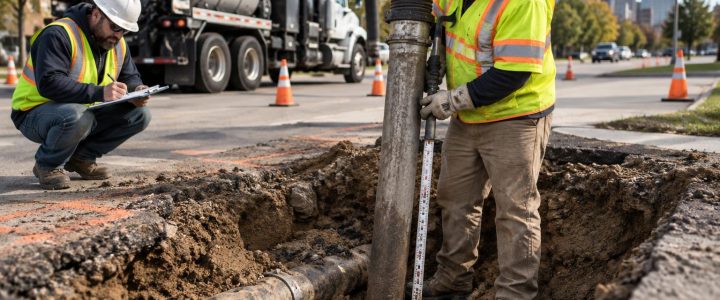
New underground pipe can be covered, paved over, and placed into service long before a problem becomes visible at the surface. A post-installation pipe inspection gives contractors, engineers, and owners a chance to review accessible storm sewer, sanitary sewer, and drainage systems while defects can still be assigned, corrected, and documented.
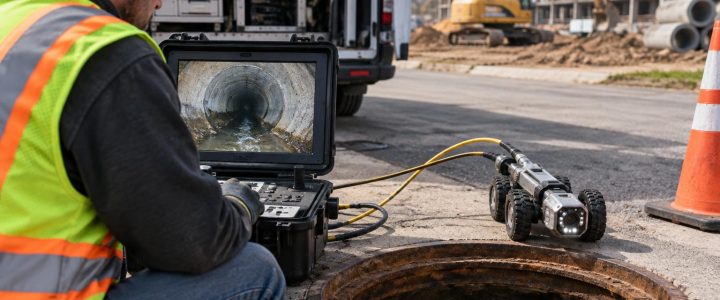
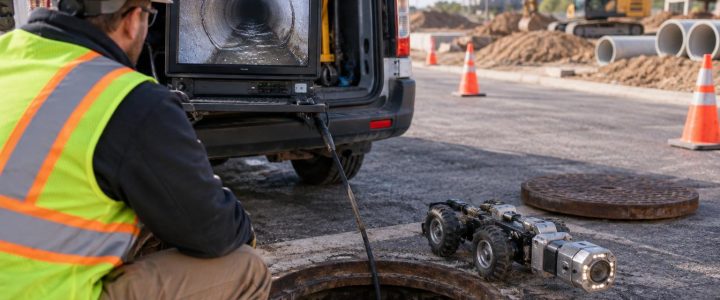
A professional video pipe inspection is not a substitute for installation observation, compaction testing, pressure testing, leakage testing, or engineering review where those items are required. It is a practical visual tool. A crawler camera or push camera can record internal pipe conditions, connections, obstructions, and visible defects from available access points. The results can help the project team decide whether follow-up cleaning, repair, locating, testing, surveying, or excavation is needed before final acceptance.
For contractors and project managers, the important question is not simply whether the camera can travel through the pipe. The question is whether the inspection is planned well enough to produce usable evidence of pipe condition and installation quality.
Why inspect newly installed pipe before final acceptance?
New pipe is expected to be clean, continuous, properly connected, and free of installation-related damage. However, even a well-managed project can have hidden issues. A CCTV sewer inspection or stormwater pipe inspection may reveal conditions that are difficult to confirm from structures at the surface.
Common reasons to order a post-installation pipe inspection include:
- Supporting quality-control and quality-assurance reviews before closeout.
- Checking whether construction debris, sediment, grout, or other material entered the pipe.
- Reviewing connections between pipe runs, structures, laterals, and inlets.
- Looking for visible cracks, fractures, joint offsets, deformations, or damage caused during handling and backfill.
- Investigating a pipe run that will not pass water as expected.
- Creating a baseline record before pavement, landscaping, or other permanent improvements limit access.
- Providing organized video and observations for the owner, engineer, or accepting agency.
- Resolving concerns before warranty obligations, restoration work, or demobilization make repairs more disruptive.
A camera finding does not automatically establish the cause, severity, or structural significance of a condition. For example, a visible joint gap may warrant review of installation records, measurements, testing, or engineering evaluation. A camera provides evidence; the appropriate response depends on the pipe material, diameter, function, owner requirements, and project specifications.
Plan the inspection before the site is finished
The best time to plan a post-installation pipe inspection is before the final surface work begins. Waiting until the end of the project can leave crews with blocked cleanouts, buried structures, standing water, or incomplete access to key pipe runs.
Define the inspection limits
Start with a simple pipe schedule or marked utility plan. Identify each run to be inspected, the upstream and downstream structures, the expected pipe material and size, and any laterals, branches, or special structures that need attention. This helps prevent uncertainty about which segment appears in each video file.
For storm sewer work, the inspection limits may include inlet leads, main runs, culverts, junction structures, underdrain outlets, or other accessible drainage piping. For sanitary sewer work, the scope may include mains, services, cleanout-to-main segments, and accessible laterals.
Confirm access and equipment suitability
Pipe diameter, bends, access structures, flow, and pipe configuration affect what can be inspected. A robotic pipe inspection crawler may be suitable for many larger, accessible runs, while a push camera may be more appropriate for smaller pipe or service laterals. Some systems cannot be fully inspected from the available access points.
Limited access does not mean the pipe has failed. It means the project team should understand the inspection coverage and decide whether another access point, cleaning method, or investigation approach is justified.
Schedule cleaning when needed
Construction sediment, gravel, wood, plastic, concrete residue, and other debris can obscure the pipe wall or stop a camera. Cleaning may be needed before the inspection can provide a meaningful view. The goal is not just to get equipment through the line; it is to make the interior visible enough to assess observable conditions.
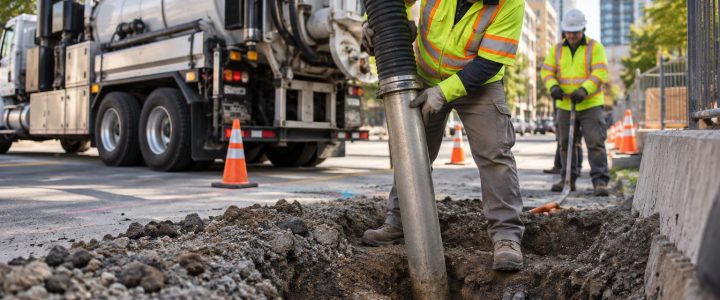
Cleaning should be coordinated carefully. High-pressure cleaning, vacuum work, or other methods may be appropriate depending on the pipe and site conditions, but the selected method should suit the system and project requirements. After cleaning, an inspection can document whether material was removed and whether visible defects remain.
Post-installation pipe inspection checklist
The following checklist can help a contractor or engineer prepare a productive inspection scope. Project specifications and owner requirements should always control.
- Confirm pipe runs and access points. Identify structures, inlets, cleanouts, manholes, and outfalls that will be used for camera entry or retrieval.
- Provide available plans and installation information. Give the inspection team current plan sheets, pipe schedule information, known pipe sizes, and any changes made in the field.
- Review safety and site access. Coordinate traffic control, work-area access, structure hazards, and any confined-space requirements. Camera work does not eliminate the need for safe structure access and site controls.
- Evaluate cleaning needs. Identify pipe segments affected by sediment, standing water, debris, grease, roots, or construction residue that may limit visibility.
- Identify acceptance questions. Clarify whether the inspection is intended to document completion, investigate drainage performance, verify a connection, support a repair decision, or provide an existing-condition record.
- Establish file naming and reporting expectations. Agree on how pipe runs, structures, dates, direction of travel, footage, observations, and video files will be identified.
- Review findings promptly. Inspectors can document observations, but the contractor, engineer, and owner should review items requiring correction while crews and equipment are still available.
- Document corrective work. If a pipe is cleaned, repaired, or replaced, consider a follow-up video inspection of the affected segment to show the condition after the work.
What a CCTV inspection can reveal in new pipe
Professional CCTV pipe inspection can provide visual documentation of conditions inside accessible piping. Depending on visibility and equipment access, the video may show:
- Construction debris, sediment deposits, or blockages.
- Visible cracks, fractures, holes, or damaged pipe wall.
- Open, displaced, offset, or otherwise irregular joints.
- Deformation, sagging indicators, or localized collapse that may need further evaluation.
- Intruding gaskets, protruding service connections, or poorly finished penetrations.
- Missing, blocked, or questionable-looking connections.
- Root intrusion in systems connected to older infrastructure or installed near root zones.
- Evidence of flow paths, standing water, or infiltration observed during the inspection.
Video is especially useful when a newly installed system has a performance issue. If an inlet remains ponded, a pipe will not drain, or a sanitary line has recurring backup concerns during construction, the video can narrow the investigation. It may show debris, a connection issue, a blockage, or an unexpected change in the pipe path. It may also show that the camera could not proceed beyond an obstruction, which is itself useful information for planning the next step.
Pipe inspection is not the same as pipe locating
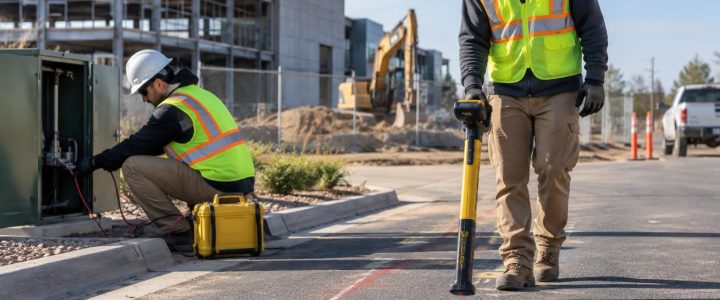
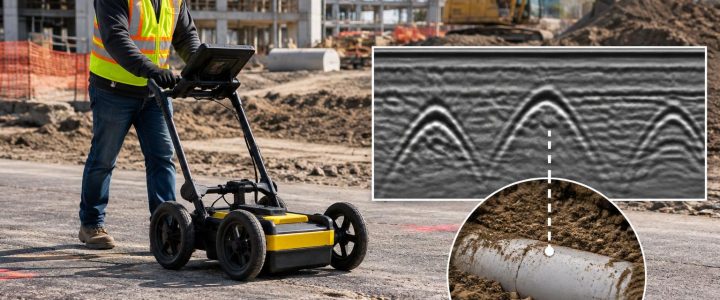
Camera inspection, underground pipe locating, and condition assessment are related but different tasks. A camera can help establish the route of an accessible pipe by documenting its travel through the system and identifying recognizable features such as junctions, inlets, laterals, or defects. A sonde-equipped camera may also be traceable from the surface in suitable conditions.
However, a video inspection alone does not always create a precise surveyed horizontal or vertical pipe location. Depth readings can be affected by field conditions and locating method. Where design, excavation, or conflict decisions depend on reliable coordinates or elevations, the team may need additional private utility locating, survey control, test holes, or other subsurface investigation.
Likewise, observing a crack or deformation does not, by itself, determine why it occurred or whether the pipe has sufficient structural capacity. Those decisions may require engineering judgment, additional testing, excavation, or review of installation and material records.
Use standardized observations when the project requires them
For larger municipal, infrastructure, or asset-management programs, owners may request standardized condition coding. NASSCO’s Pipeline Assessment Certification Program (PACP) provides a common vocabulary for documenting observations in pipelines, while the Lateral Assessment Certification Program (LACP) applies similar concepts to laterals. These systems can improve consistency when comparing pipe conditions across many assets.
Not every video sewer inspection is a PACP or LACP assessment. If standardized coding, certified personnel, specific deliverable formats, or database compatibility is required, define those requirements in the scope before fieldwork starts. The project team should also confirm whether the owner has separate acceptance criteria for new storm sewer or sanitary sewer installation.
Common post-installation findings and practical next steps
Debris or sediment in the pipe
First determine whether cleaning can restore full visibility and flow. After cleaning, a follow-up inspection can show whether the issue was limited to loose material or whether a physical defect remains.
A visible joint problem or damaged wall
Record the pipe run, approximate camera distance, direction of travel, and nearby structures. The engineer or owner can then determine whether repair, testing, excavation, or further review is appropriate. Avoid assuming the visible appearance alone establishes the extent of the problem.
A camera cannot pass
Document where progress stopped and what is visible. The limitation could result from a blockage, severe bend, diameter change, standing water, deformation, debris, or inaccessible configuration. Cleaning, alternate access, locating, or targeted excavation may be needed to identify the reason.
An unexpected connection or pipe route
Compare the video observations with current plans and field changes. When the route affects construction conflicts, grading, ownership boundaries, or future maintenance, additional locating and survey work may be appropriate.
FAQ: post-installation video pipe inspection
Should a new storm sewer be cleaned before CCTV inspection?
Often, yes. If sediment or construction debris prevents a clear view of the pipe wall, cleaning can make the inspection more useful. The needed preparation depends on the pipe condition, access, water level, and project requirements.
Can CCTV confirm that every pipe connection is correct?
CCTV can visually document accessible connections and may identify missing, blocked, or irregular-looking connections. It cannot confirm every connection in every system, especially when the camera cannot access a segment or visibility is limited. Plans, testing, locating, and field verification may still be needed.
Can a sewer camera determine exact pipe depth?
Not reliably on its own. Camera footage and a traceable sonde can support pipe-route investigation, but exact horizontal position and elevation generally require an appropriate locating and surveying process. Where excavation safety or design depends on depth, consider direct verification methods.
What should be included in a post-installation inspection deliverable?
A useful deliverable typically identifies the inspected pipe run, access points, inspection direction, date, video files, observations, and areas where coverage was limited. The required format should be confirmed with the project owner or engineer before the inspection.
Make inspection part of the acceptance plan
A post-installation pipe inspection is most valuable when it is planned as part of construction quality control rather than treated as a last-minute closeout item. Clear scope limits, accessible structures, adequate cleaning, organized records, and timely review help the project team turn video findings into practical decisions.
Visionary Subsurface Solutions provides professional video pipe inspection for accessible stormwater, sanitary sewer, drainage, and underground piping systems throughout Pennsylvania, New Jersey, Delaware, Maryland, New York, and the Washington, D.C. to New York City corridor. Contact our team to discuss inspection access, project documentation needs, and the right investigation approach for your project.