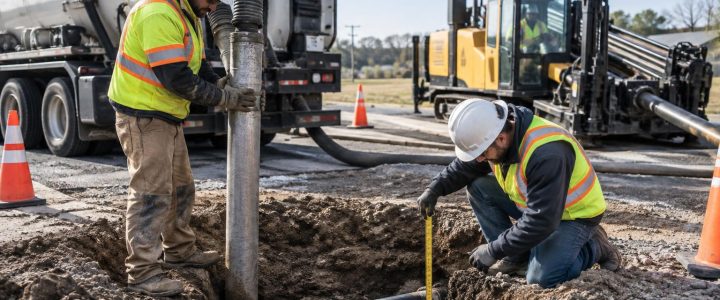
Concrete coring, saw cutting, anchor drilling, and slab penetrations can look like small tasks on a construction schedule. They can become major problems when the work intersects post-tension tendons, reinforcing steel, electrical conduit, plumbing, or unknown embedded features.
GPR concrete scanning is a non-destructive investigation method that helps a project team assess what may be inside a concrete slab, wall, deck, or structural member before work begins. It does not create an X-ray image or identify every object with certainty. Instead, it records reflections caused by changes in electromagnetic properties within the material. A trained technician reviews those reflections, scan patterns, site conditions, and available plans to identify likely embedded features and help define lower-risk work areas.
For contractors and engineers, the practical question is not simply, “Can GPR see through concrete?” It is: “Do we have enough reliable information to choose a coring, cutting, or drilling location safely?” The answer may involve GPR, a review of drawings, electromagnetic locating where appropriate, selective verification, and coordination with the engineer of record.
Why scan concrete before cutting or coring?
Scanning is most valuable when an unplanned strike would affect safety, structural performance, operations, or the project schedule. This includes work in active facilities, multi-story buildings, parking structures, hospitals, industrial plants, campuses, and renovations where record drawings may be incomplete or outdated.
A professional scan can help identify areas that may contain:
- Reinforcing bars, welded-wire reinforcement, and closely spaced steel
- Post-tension tendons and related hardware
- Electrical conduits, including some non-metallic conduits
- Plumbing lines, sleeves, and embedded piping
- Voids, delamination-related anomalies, patches, or changes in slab construction
- Prior openings, abandoned embedded features, or unexpected obstructions
The objective is to give the team better information before committing to a location. It is not a substitute for the structural engineer’s direction, required permits, or safe work planning.
How ground penetrating radar detects embedded features
A GPR antenna sends short electromagnetic pulses into the concrete. When the pulse encounters a boundary between materials with different electrical properties, part of the energy can reflect back to the antenna. Steel, air gaps, conduits, moisture changes, aggregate variations, and boundaries between concrete pours can all create reflections.
As the antenna moves across the surface, a technician collects many closely spaced readings. A point-like target commonly produces a curved response in a profile view. Linear features become more meaningful when they are seen repeatedly across a planned grid and their direction can be traced.
GPR data requires interpretation. A strong reflection may indicate steel, but reflection strength alone does not prove an object’s material, purpose, ownership, or condition. Likewise, a weak or absent response does not prove that an area contains no embedded feature. A professional report should communicate both the interpreted findings and important limitations.
Technical guidance from the Federal Highway Administration and the U.S. Army Corps of Engineers describes GPR as a useful non-destructive evaluation tool while emphasizing that material properties, moisture, antenna selection, survey design, and experienced interpretation affect results. FHWA nondestructive evaluation resources and the U.S. Army Corps of Engineers GPR guidance provide useful technical background for project teams.
What a concrete GPR survey can provide
The deliverable should match the decision the team needs to make. Before a single core, the work may focus on a small marked area. Before a large renovation, the survey may involve a broader grid, plan-view mapping, selected profiles, and coordinated field markings.
Field markings for immediate work decisions
For active coring or cutting work, technicians often mark interpreted features directly on the accessible surface. Marking conventions should be agreed upon before scanning begins. The crew needs to know which marks indicate likely reinforcement, probable conduits, scan limits, proposed openings, or areas requiring further review.
A clear marked surface is useful only if it remains visible and protected. Painting, grinding, layout work, water, dust, and other trades can quickly obscure markings. Photograph the marked area with reference dimensions before the crew mobilizes.
Documentation for design and coordination
For engineering, renovation, or dispute-avoidance purposes, a report may include the survey area, scan layout, interpreted features, field photographs, limitations, and recommended next steps. Dimensions should be tied to practical site control where possible. Do not assume that a sketch or GPR image alone provides survey-grade coordinates unless the scope specifically includes that level of control and documentation.
Important limits: GPR does not “see everything”
GPR concrete scanning is powerful, but it is not universal. The amount of useful information depends on the structure and the investigation objective.
Reinforcement can mask deeper features
A dense top mat of reinforcing steel can make it difficult to interpret conditions below it. Closely spaced bars, heavy reinforcement, metal decking, and multiple layers of steel create many reflections. Those reflections may obscure conduits, tendons, or other features deeper in the member.
Moisture and material conditions matter
Concrete moisture, chloride contamination, material variability, aggregate type, and the presence of moisture-filled features can affect signal behavior. GPR is not a direct moisture meter and should not be used to make a definitive condition diagnosis without an appropriate scope and supporting methods.
Depth is an interpretation, not a guaranteed measurement
GPR estimates depth by analyzing travel time and applying an assumed or calibrated signal velocity. Because velocity varies with concrete properties and conditions, depth estimates have uncertainty. Where vertical position is critical, the project team should treat GPR depth as an interpreted estimate and consider physical verification or other approved methods.
Object identity may remain uncertain
A linear response could be consistent with a conduit, pipe, tendon, reinforcement, or another embedded feature. Direction, depth, spacing, drawings, known building systems, and complementary locating methods can improve the interpretation. They do not always turn an ambiguous response into a confirmed identification.
Frequency selection: resolution and depth are a tradeoff
Higher-frequency antennas can provide sharper detail near the surface, which is often important for concrete scanning. Lower-frequency systems may be selected for deeper or larger targets in other subsurface investigations, but they generally provide less fine detail. There is no single antenna frequency or maximum depth that applies to every slab, wall, or site.
The right equipment and grid spacing depend on the member thickness, expected target size, reinforcement density, accessible surfaces, and planned work. A request to “scan as deep as possible” is less useful than explaining the actual task: for example, a 4-inch core through a suspended slab, a trench cut in a warehouse floor, or anchors installed at a defined depth.
GPR scanning versus electromagnetic locating
GPR and electromagnetic, or EM, locating are often complementary. EM locating can be highly effective when a conductive line or tracer can be accessed and energized. It may help trace a metallic conduit or a utility with an installed tracer wire. GPR can add information about features that are not directly traceable by EM, including some non-metallic conduits, sleeves, and other anomalies.
Neither method should be treated as a universal replacement for the other. A conduit may be difficult to detect with GPR because of dense reinforcement, yet traceable by EM. A non-conductive sleeve may not respond to EM, but may produce an interpretable GPR response under favorable conditions. The investigation plan should use the methods that fit the known conditions and the consequence of a strike.
For exterior work that connects a building penetration to excavation, it is also important to investigate private-side utilities beyond the structure. Visionary Subsurface Solutions can coordinate Private Utility Locating with GPR services when the work area includes both the slab and surrounding site utilities.
A practical workflow before drilling, coring, or saw cutting
- Define the proposed work. Provide the opening size, core diameter, saw-cut limits, drilling depth, and planned locations. A scan area should extend beyond the exact opening when conditions and access allow.
- Gather available information. Share structural drawings, MEP drawings, renovation records, utility plans, and known restrictions. Drawings are valuable context, but they should not be treated as proof of as-built conditions.
- Prepare the surface. Remove loose materials, stored items, standing water, and obstructions where practical. Identify coatings, floor coverings, curbs, equipment bases, or other access limitations in advance.
- Coordinate access and safety. Arrange access to occupied rooms, restricted areas, ceilings, and both sides of a wall when relevant. Identify the person authorized to adjust a proposed opening after findings are reviewed.
- Review markings before work starts. The superintendent, operator, trade foreman, and any engineer involved in the decision should understand the markings and limitations. Do not rely on a verbal handoff alone.
- Verify when the consequence requires it. If findings indicate a possible tendon, energized conduit, critical pipe, or structural concern, stop and determine the appropriate verification path with qualified project personnel.
Common mistakes that reduce the value of a scan
- Scanning only the exact center of a proposed opening, leaving no context for nearby crossings or offsets
- Requesting a scan after the layout and work sequence are already fixed, with no allowance to move the opening
- Assuming every line on a drawing exists exactly where shown
- Using GPR results to authorize cutting through a post-tensioned or structurally sensitive member without engineering review
- Allowing markings to be covered, removed, or misread before the work crew arrives
- Treating a clear-looking scan area as a guarantee that no embedded feature is present
When to bring in professional GPR services
Professional GPR utility detection and concrete scanning are especially appropriate before work in older buildings, active facilities, heavily reinforced slabs, unknown structures, areas with incomplete records, and locations where an accidental strike could disrupt operations or create a serious repair issue. They are also useful when a contractor needs documented information to support a safer construction decision.
Bring the investigation in early enough to adjust the layout, not after crews and equipment are waiting at the work face. When the scan identifies uncertainty, that is still useful information: it tells the team where additional review, alternate locations, or verification may be needed.
FAQ: GPR concrete scanning for construction
Can GPR find PVC or other plastic conduit in concrete?
Sometimes. GPR may detect a plastic conduit because the conduit, its contents, surrounding air space, or the material contrast around it creates a response. Results depend on conduit size, depth, orientation, moisture, reinforcement, and concrete conditions. GPR cannot reliably guarantee detection of every non-metallic conduit.
Can GPR identify a post-tension tendon with certainty?
GPR can help identify responses and patterns that may be consistent with tendons, particularly when supported by plans and expected tendon layouts. However, interpretation can be complicated by reinforcement and other embedded features. Any action affecting a potentially post-tensioned member should be coordinated with the engineer of record and the project’s structural procedures.
Is a GPR scan enough before every concrete penetration?
Not always. The required level of investigation depends on the member, expected embedded features, penetration size and depth, consequences of a strike, and available records. GPR may be one important step in a larger planning and verification process.
Plan the investigation around the decision
The best GPR survey is not the one that produces the most data. It is the one designed around a clear construction decision: where to core, where to cut, where to drill, or whether a proposed opening should move. Defining that decision, sharing available plans, and understanding the limits of the method will produce more useful results.
Visionary Subsurface Solutions provides practical GPR concrete scanning and subsurface investigation support for projects throughout Pennsylvania, New Jersey, Delaware, Maryland, New York, and the Washington, D.C. to New York City corridor. Contact our team to discuss your proposed coring, cutting, drilling, or utility investigation work and the information needed before construction begins.