Recurring sewer backups at a commercial building, industrial facility, campus, or multifamily property are more than a maintenance nuisance. They can interrupt operations, damage finishes, create sanitation concerns, and leave project teams guessing about where to repair. A professional commercial sewer camera inspection can provide useful visual evidence before a contractor excavates, cleans repeatedly, or recommends replacement.
The purpose is not simply to put a camera in a pipe. The goal is to understand what can be observed inside the accessible line: the apparent location and extent of an obstruction, changes in pipe condition, lateral connections, joint issues, standing water, roots, debris, or other features that may be affecting service. The inspection record can then help the owner, facilities manager, engineer, or contractor choose a more informed next step.
A camera inspection does have limits. Video may show a defect, but it does not by itself establish the exact survey position, depth, ownership, structural capacity, or underlying cause of every observed condition. Some situations require cleaning, pipe locating, surveying, test holes, flow testing, or engineering review in addition to CCTV.
Why recurring sewer backups need a documented investigation
Repeated clearing without identifying the condition of the pipe can become expensive and disruptive. A drain may open after jetting or snaking, only to back up again weeks later because roots, a displaced joint, accumulated grease, a sag, or a damaged section remains in the system.
For a commercial property, the source of a backup may also be outside the portion of piping that building staff normally maintain. It could involve a building sewer, a private lateral, a site sewer main, a connection, or a transition between different pipe materials and installation periods. The responsible party and appropriate repair method should be confirmed through project-specific records and investigation rather than assumed from video alone.
A CCTV sewer inspection is often useful when a team needs to answer practical questions such as:
- Is there a visible blockage, and how far can the camera travel?
- Are roots, grease, sediment, wipes, construction debris, or other material restricting flow?
- Is the pipe visibly cracked, fractured, deformed, separated, or collapsed?
- Are there open, offset, or displaced joints?
- Can visible laterals, connections, cleanouts, and manholes help explain the system layout?
- Does the line appear to hold water in a low area?
- Is the affected pipe accessible for cleaning, repair, lining evaluation, or replacement planning?
What a professional video pipe inspection involves
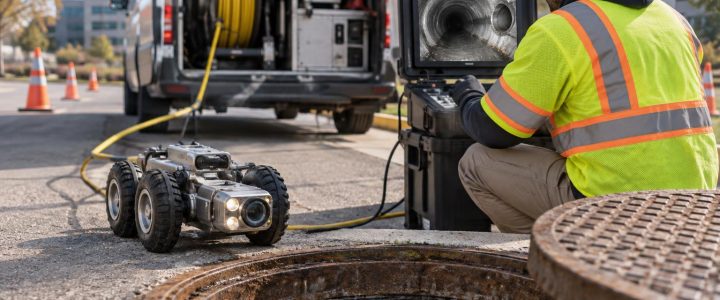
In a typical sewer camera inspection, a camera is introduced through an available cleanout, manhole, vault, or other suitable access point. The camera travels through the pipe while the operator records video and observations. Equipment selection depends on pipe diameter, access conditions, line configuration, expected travel distance, and the type of pipe being inspected.
Small-diameter building sewers and laterals may be inspected with push-camera equipment. Larger gravity sewers, storm lines, and accessible mains may call for a crawler or robotic pipe inspection system. A powered crawler can provide controlled movement and, in appropriate conditions, a clearer view of larger pipe segments and connections.
Field conditions matter. Heavy flow, standing water, grease, sediment, roots, sharp bends, collapsed pipe, or a complete obstruction may prevent the camera from reaching the full line. In those cases, the inspection should clearly identify what was accessible, the direction of travel, and the point where progress stopped. It is better to document an inspection limit honestly than to assume pipe condition beyond it.
Cleaning may be necessary before meaningful inspection
A camera cannot see through heavy debris. If the pipe contains substantial sediment, grease, roots, or accumulated material, cleaning may be needed before or during the investigation. Cleaning and CCTV are related but distinct activities: cleaning removes material to restore access or flow, while video inspection documents observable conditions.
For recurring backups, an effective sequence may be to clean the line, inspect it promptly afterward, and preserve the resulting video and observations. This can help distinguish a one-time maintenance issue from a recurring condition that needs repair planning.
Common conditions found during CCTV sewer inspection
Video inspection can reveal many visible conditions that affect sanitary sewer performance. The significance of any observation depends on its location, severity, pipe material, service demands, and the broader system context.
Obstructions and flow restrictions
Grease buildup, wipes, rags, mineral deposits, sediment, and debris can narrow the available flow area. On commercial sites, food-service operations, high-use restrooms, construction activity, and poor housekeeping practices can contribute to recurring deposits. A camera may show where material has collected, but finding the operational source may require maintenance review and coordination with facility staff.
Root intrusion
Roots commonly enter through joints, cracks, broken connections, and other openings. A camera can show visible roots and their approximate position along the inspected run. However, video alone may not show the full extent of voids outside the pipe or confirm how much structural damage exists behind the visible opening.
Joint and alignment problems
Open joints, offset joints, separated joints, and visible changes in alignment can allow soil or groundwater to enter the pipe and may create points where debris catches. In gravity pipe, poor alignment can also contribute to deposits and sluggish flow. The video record helps identify the observed condition; an engineer or qualified repair team should determine whether rehabilitation, spot repair, replacement, or further investigation is warranted.
Cracks, fractures, holes, and deformation
A camera can document visible cracks, fractures, holes, broken pipe, or deformed sections. These observations are important because they may affect pipe performance and can indicate potential loss of surrounding support. Still, visual evidence does not automatically define the remaining structural capacity of the pipe. Where structural concerns are present, the project team may need additional evaluation before selecting a repair method.
Standing water and suspected low areas
Water remaining in a line after normal flow conditions can be consistent with a low area, restricted outlet, or other drainage issue. A camera observation alone does not prove the grade or elevation of the pipe. Surveyed inverts, locating data, cleaning results, and hydraulic evaluation may be needed to determine why water is holding in the system.
Pipe inspection, pipe locating, and condition assessment are different services
These terms are often used together, but they answer different questions. Understanding the distinction can prevent gaps in scope.
- Pipe inspection documents observable internal pipe conditions, accessible route features, connections, and obstructions through video.
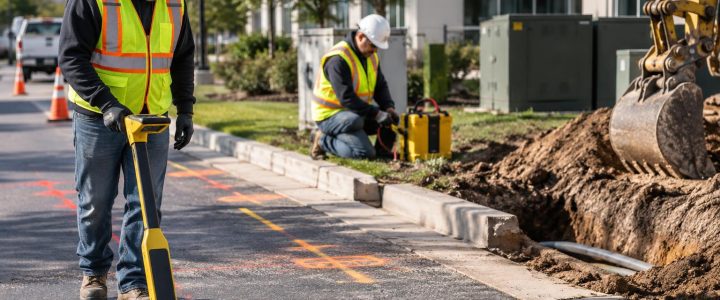
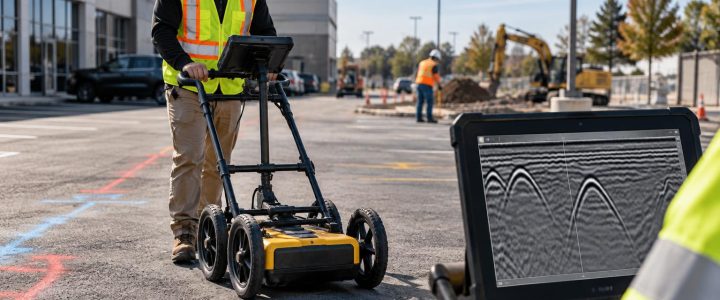
- Pipe locating helps trace a detectable route from the surface, often by tracking a sonde or transmitter associated with inspection equipment when field conditions allow.
- Condition assessment organizes and interprets observations to support maintenance, rehabilitation, or capital-planning decisions. It may use standardized coding methods or project-specific criteria.
For example, a camera may identify a root mass near the end of an accessible run. Locating may help establish an approximate surface position for that observed feature. A surveyor may be needed if project plans require surveyed coordinates or elevations. If excavation is planned near other utilities, private utility locating and, where necessary, physical verification may be appropriate before digging.
Likewise, a camera can reveal a visible fracture but cannot always determine why it occurred. The cause could involve settlement, traffic loading, installation issues, soil movement, connection stress, or another condition that requires further project-specific investigation.
How CCTV findings support repair and maintenance decisions
A commercial sewer camera inspection creates a baseline record that can help teams move from a reported symptom to a focused work plan. It is especially useful before major excavation or repeated emergency service calls.
Depending on the accessible pipe and project needs, an inspection record can support:
- Targeted cleaning and root-control planning
- Spot repair investigation for a localized visible defect
- Evaluation of whether a line should be considered for rehabilitation or replacement
- Documentation before tenant improvements, paving, utility work, or redevelopment
- Coordination between facility staff, plumbers, civil engineers, and contractors
- Budget development based on known accessible conditions rather than assumptions
- Comparison inspections after cleaning, repair, or construction activity
For municipal and larger facility systems, standardized condition assessment can also improve consistency across many pipe segments. NASSCO’s Pipeline Assessment Certification Program, commonly called PACP, provides a standardized approach for documenting observed conditions in gravity pipelines. LACP is a related protocol for laterals. A request for a PACP- or LACP-coded inspection should be stated clearly in the scope; a standard video alone is not automatically a coded assessment or a certification of pipe condition.
For background on those standardized assessment programs, see NASSCO’s PACP information and the U.S. EPA’s asset management resources. These resources both describe the value of organized condition information for managing infrastructure, while the appropriate inspection format should always match the project requirements.
What to request in a professional inspection deliverable
Before scheduling a sewer pipe inspection, provide the best available information: address, access locations, pipe use, known backup points, prior cleaning records, available plans, and any safety or site-access requirements. The inspection provider can then help determine whether the line is a practical candidate for CCTV and what preparation may be needed.
A useful deliverable often includes:
- Video files or a viewable inspection record
- Pipe segment identification and direction of travel
- Access points used and the portion of line reached
- Observed features and defects, with distance references where equipment and field conditions support them
- Notes on obstructions, cleaning needs, or access limitations
- Still images of important observations when appropriate
- Locating information when that service was included and conditions allowed tracing
- Recommendations for additional investigation when video cannot resolve the question
Distance readings on inspection equipment are valuable references, but they should not be treated as surveyed horizontal or vertical coordinates without appropriate verification. This is particularly important when a repair will occur near buried utilities, structures, or pavement.
FAQ: commercial sewer camera inspections
Can a sewer camera find the exact location of a damaged pipe?
Not by itself. A camera can document a defect along an accessible run and may be used with a transmitter to assist with surface tracing. Exact design or excavation coordinates generally require appropriate locating and, when needed, survey control or physical verification.
Can CCTV prove that a pipe must be replaced?
No. Video can document visible conditions that may support repair or replacement evaluation. The repair decision should consider the observed defect, pipe function, recurrence of problems, access, site constraints, cleaning results, and any needed engineering assessment.
What if the camera cannot pass a blockage?
The inspection can document the accessible portion and the apparent point of restriction. Cleaning, root removal, alternative access, or excavation may be necessary before the remaining pipe can be evaluated.
Is a sewer camera inspection useful after a backup has been cleared?
Often, yes. Inspecting after cleaning can help identify visible conditions that caused or contributed to the blockage and establish a documented baseline for maintenance or repair planning.
Plan the next step with field evidence
When a commercial sewer line backs up repeatedly, the fastest apparent fix is not always the best long-term answer. Video inspection can replace uncertainty with a clear record of what is visible inside the accessible pipe, where the inspection reached, and what additional work may be needed to resolve the problem responsibly.
Visionary Subsurface Solutions provides professional video pipe inspection for sanitary sewer, stormwater, drainage, and other accessible piping systems throughout Pennsylvania, New Jersey, Delaware, Maryland, New York, and the Washington, D.C. to New York City corridor. Contact our team to discuss the access conditions, project goals, and inspection documentation your site requires.