A storm sewer camera inspection is most useful when it produces more than a video file. Contractors, engineers, municipalities, and property managers need clear information they can use to decide what to clean, repair, investigate further, or include in a construction scope.
A professional storm sewer inspection report should connect field observations to specific pipe segments, structures, and locations. It should help the project team understand what was visible inside the system, where notable conditions were observed, and which questions remain unresolved.
That distinction matters. A CCTV inspection can document visible conditions such as sediment, displaced joints, root intrusion, cracks, connection openings, debris, and deformation. It does not automatically establish the exact surveyed route or elevation of a pipe, prove the cause of a defect, or determine whether a pipe has adequate structural capacity. Those questions may require pipe locating, survey control, cleaning, testing, vacuum excavation, or engineering review.
Why storm sewer inspection reports matter
Stormwater systems often receive attention only after a drainage failure, pavement settlement, sinkhole concern, flooding complaint, or construction conflict. By then, the project team may be working from incomplete drawings and assumptions about pipe route, size, connectivity, and condition.
A documented storm sewer inspection gives the team a common factual starting point. It can support practical decisions before rehabilitation, site redevelopment, maintenance work, property acquisition, or acceptance of drainage infrastructure.
Common reasons to order an inspection include:
- A catch basin or inlet drains slowly after rain.
- Water ponds in a parking lot, loading area, roadway, or landscaped basin.
- A culvert or storm line is suspected to be blocked or damaged.
- Plans show a drainage system, but the existing route or connections are uncertain.
- A proposed utility crossing, excavation, or structure may conflict with an existing storm line.
- An owner needs condition documentation before nearby construction begins.
- An engineer is developing a repair, lining, replacement, or maintenance scope.
- A contractor needs to confirm that accessible new pipe is clear and connected as intended.
For active projects, the report should be understandable to someone who was not present during the inspection. That includes the design engineer, owner representative, estimator, maintenance supervisor, construction manager, or inspector reviewing the work later.
What a professional CCTV storm sewer report should include
The exact format depends on the assignment, available access, pipe type, and owner requirements. Still, a useful underground pipe inspection deliverable generally includes the items below.
Project and inspection scope
The report should identify the site, inspection date, client or project reference, and the assigned scope. It should also state what was inspected and what was not inspected.
For example, the scope may cover runs from one catch basin to another, a line from an inlet to an outfall, or only portions accessible from selected structures. Clear scope language prevents a partial inspection from being mistaken for a complete system assessment.
Access points and pipe segment identification
Every inspected run should be tied to identifiable structures whenever possible. These may include manholes, catch basins, inlets, cleanouts, junction boxes, headwalls, or outfalls.
Useful identifiers can include structure labels from plans, field labels, descriptive names, or a project-specific numbering system. If existing identifiers are missing or unreliable, the report should explain how the structures were designated in the field.
This is especially important on commercial properties and older municipal systems, where several drainage lines may converge and record drawings may not match current field conditions.
Pipe details observed in the field
The report may document pipe diameter, apparent material, shape, flow direction, entry and exit points, and the distance inspected. These observations help establish a working picture of the system.
However, video-based material identification should be treated carefully. A camera may show characteristics consistent with concrete, corrugated metal, plastic, clay, or another material, but coatings, sediment, corrosion, age, and limited visibility can make confirmation difficult. Where pipe material affects design or repair decisions, the project team may need to verify it through records, exposed evidence, or other investigation.
Inspection video and still images
Video is the primary record of what the camera observed. A quality report should make it easy to connect the footage to the inspected segment. Still images are also helpful for quickly reviewing notable conditions without searching through a full video.
Good documentation typically associates images and observations with a distance along the run, an upstream or downstream structure, or another clear reference. This gives the team a practical way to return to a condition later for cleaning, repair, survey, or excavation.
Observed conditions and obstructions
The report should describe visible features in plain language and identify their approximate position in the inspected reach. Depending on conditions, observations may include:
- Sediment, gravel, leaves, trash, construction debris, or other deposits
- Roots entering through joints, cracks, or connections
- Offset, open, separated, or displaced joints
- Cracks, fractures, holes, corrosion, or missing wall material
- Deformation, sagging, collapse, or restricted diameter
- Standing water, active flow, or evidence that visibility was limited by water level
- Unknown connections, laterals, taps, or branch lines
- Infiltration observed entering the pipe through defects or joints
- Surface material or other evidence suggesting a possible connection issue
Descriptions should distinguish between what was directly observed and what is only a possible interpretation. For instance, a camera can show a void-like opening, soil visible through a defect, or a broken pipe wall. It cannot by itself determine the full extent of external soil loss or confirm the structural consequences without further evaluation.
Inspection limitations
This section is not a formality. It tells the project team how much confidence to place in the visual record.
Stormwater pipe inspection can be limited by high water, sediment, debris, heavy root masses, tight bends, diameter changes, inaccessible structures, damaged access covers, blocked lines, and complete or partial collapse. A camera may be unable to pass a restriction, or it may pass while the view remains partly obscured.
The report should identify where the inspection stopped, why it stopped, and what portion of the line was not visible. If cleaning is needed before a meaningful condition assessment can be completed, that should be stated directly.
Pipe inspection, pipe locating, and condition assessment are different tasks
These services often work together, but they answer different questions.
Video pipe inspection
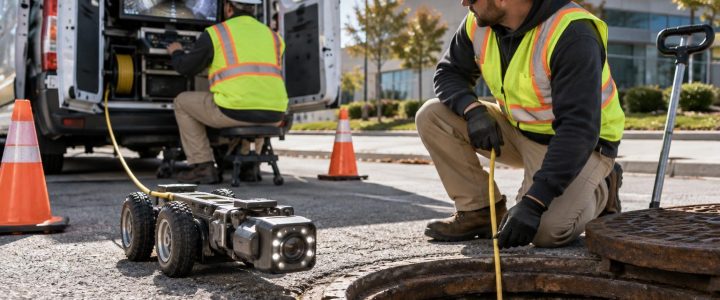
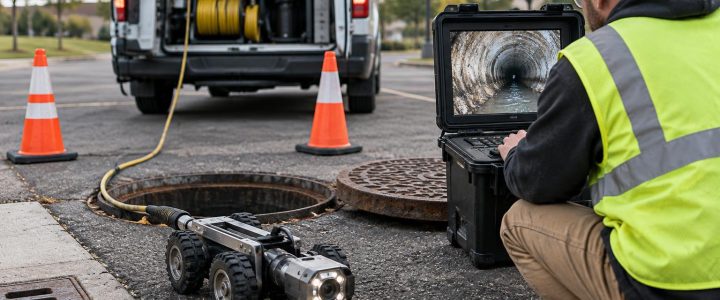
CCTV or robotic pipe inspection documents the interior of an accessible pipe. It can help establish connectivity between structures, reveal visible defects and obstructions, and show the condition of the portions the camera can reach and see.
Pipe locating
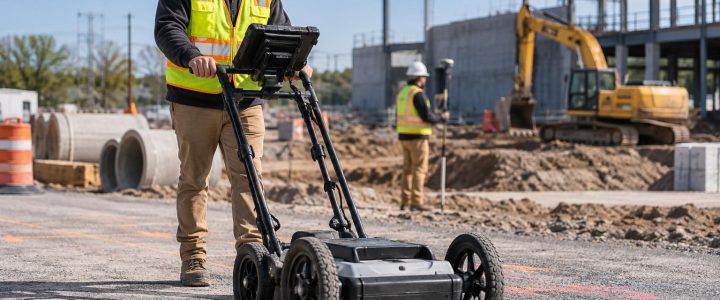
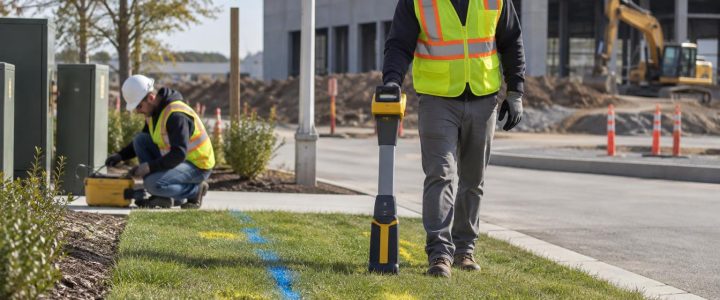
Pipe locating aims to establish the horizontal route and, when feasible, depth of an underground line. A sonde on a camera or other locating method may help trace a reachable pipe from the surface, but field conditions, access, interference, depth, and pipe configuration can affect results. A camera inspection alone should not be treated as a surveyed utility map.
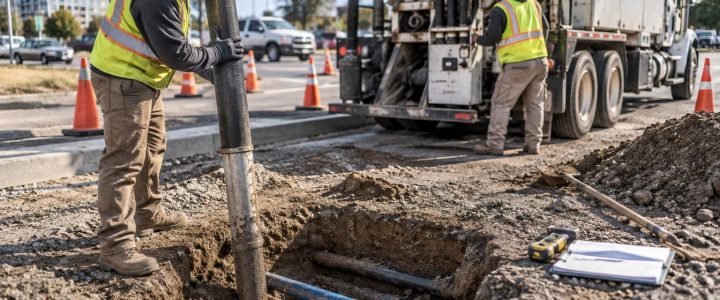
When route information is needed for design or excavation planning, professional private utility locating and survey coordination may be appropriate. Where a critical point must be physically confirmed, a carefully planned test hole can provide a higher level of confidence.
Condition assessment
Condition assessment uses inspection observations to organize and evaluate a pipe’s visible defects and serviceability concerns. It may help prioritize maintenance or rehabilitation, but an engineer should evaluate structural significance, hydraulic performance, and repair design when those decisions are required.
For owners that require standardized coding, NASSCO’s Pipeline Assessment Certification Program, commonly called PACP, provides a consistent framework for recording pipe observations. LACP is the related standard for laterals. Not every CCTV sewer inspection is a PACP- or LACP-coded inspection, so project specifications should state whether standardized coding, certified personnel, and specific electronic data formats are required.
How to use findings from a stormwater pipe inspection
A report is most valuable when the next steps match the actual problem. The following approach can help keep the investigation focused.
- Separate immediate restrictions from longer-term defects. Sediment, debris, and root masses may call for cleaning. A displaced joint, fracture, or deformation may need further evaluation even after flow is restored.
- Confirm the affected pipe segment. Tie the finding to known structures, available plans, and field references. If the route remains uncertain, add locating or survey work rather than relying on assumptions.
- Decide whether the line needs preparation and reinspection. A heavily silted line may hide the condition of the pipe wall and joints. Cleaning followed by CCTV can provide a more complete view.
- Use evidence to develop the repair scope. Video, images, observed distances, and structure references can help engineers and contractors identify where targeted excavation, point repair, rehabilitation, or replacement may be warranted.
- Document conditions before work changes the system. Pre-construction CCTV inspection can establish a baseline for pipes near proposed grading, utility work, paving, or structures.
Questions to ask before scheduling a CCTV inspection
Better planning improves the chance of obtaining useful video and a report that fits the project need. Before mobilization, gather available utility plans, drainage plans, structure maps, prior inspection videos, and maintenance records. Then discuss the following:
- Which pipe runs, structures, outfalls, or problem areas are the priority?
- What is the purpose: blockage investigation, design, maintenance planning, documentation, or construction acceptance?
- Are manholes, catch basins, cleanouts, and outfalls accessible and safe to open?
- Is cleaning needed before inspection because of sediment, grease, roots, or debris?
- Are there active flows, tide influences, bypass needs, or weather conditions that could affect visibility?
- Does the owner require PACP-style coding, a specific naming convention, GIS-ready data, or particular report formats?
- Will the findings need to be connected to survey control, utility mapping, or design drawings?
For complex structures, a related service such as 3D manhole LiDAR scanning may help document interior geometry and connections that are difficult to capture through conventional video alone.
FAQ: storm sewer inspection reports
Can a CCTV inspection locate a storm drain line?
It can help establish a pipe route from accessible structures and may support surface tracing when suitable locating equipment and field conditions are available. It does not always provide a precise surveyed horizontal alignment or elevation. Surveying, dedicated pipe locating, and test holes may be needed when location accuracy is critical.
Can video inspection prove why a pipe failed?
No. Video can document visible damage and conditions that may warrant further investigation. Determining the underlying cause, structural severity, soil condition, or repair design may require engineering analysis, excavation, testing, or review of installation records.
Should a storm line be cleaned before camera inspection?
Often, yes. Cleaning may be necessary when sediment, debris, roots, or standing water blocks the camera path or obscures the pipe wall. In some cases, an initial camera pass is still useful because it identifies the location and nature of the blockage.
What if the camera cannot travel through the full pipe run?
The report should state the point where travel stopped and the reason, such as debris, a tight bend, deformation, or collapse. The team can then decide whether cleaning, alternate access, locating, targeted excavation, or another investigation method is appropriate.
Turn inspection footage into a usable project record
A professional video pipe inspection should give the project team more than an image of a problem. It should provide a traceable record of accessible pipe conditions, inspection limits, and recommended next investigative steps when the evidence is incomplete.
Visionary Subsurface Solutions provides video pipe inspection for stormwater, sanitary sewer, drainage, and other accessible piping systems across Pennsylvania, New Jersey, Delaware, Maryland, New York, and the Washington, D.C. to New York City corridor. Contact our team to discuss the pipe access, project objectives, and documentation your project requires.